I recently published a book titled Understanding Intuition: A Journey In and Out of Science. It explores some foundational intuitions about intuition I experienced and brings them together with a deep dive into the science of intuition. It took me years to write and find a publisher. All told, it was a 2-decade long endeavor. Early in 2018, Academic Press, an imprint of Elsevier, a scientific publisher, issued the work.
Showing posts with label books. Show all posts
February 17, 2019
To Publicize or Not: Is That The Question?
I recently published a book titled Understanding Intuition: A Journey In and Out of Science. It explores some foundational intuitions about intuition I experienced and brings them together with a deep dive into the science of intuition. It took me years to write and find a publisher. All told, it was a 2-decade long endeavor. Early in 2018, Academic Press, an imprint of Elsevier, a scientific publisher, issued the work.
From the experience of my
colleagues at the Women’s Studies Research Center at Brandeis University, I
learned that once you publish a book, your job is to publicize it. Before
publication, I had assumed I would avail myself of all opportunities to promote
the book, and, truth be told, a part of me looked forward to the attention. But
I am also distrustful of the part of me that needs attention and recognition.
I did
try this or that, but almost nothing happened on the publicity front.
Fortunately, I did get two letters from stunningly intelligent readers telling that
they were deeply inspired by the book. This has helped keep me from feeling very
discouraged. More recently the book has received some endorsements from people whose work I greatly respect.
I am
also helped by an experience that occurred during the years I was having trouble
finding a publisher. I came
to recognize over time that the publishing setback was likely only temporary.
Because of the unusualness and importance of the material, I began to feel that
it would eventually find its audience—however that might happen,
and however long it might take.
But the
feeling that the book would eventually be published did not eliminate the discomfort
I felt. Then one evening while sweeping up the kitchen floor after dinner, I
confronted myself with great sincerity about why I still felt so badly about
the situation, even as I felt increasingly confident that in time the book
would find its audience. Then something extraordinary happened.
As I continued to sweep, I
felt the deepest and purist sense of spaciousness and Presence I ever have. My
consciousness was completely altered, at least for a while. I realized that
this transformed mind, which brought with it a sense of being completely safe
and secure in the cosmos, was more important than
publishing the book. The jewel was instead more easy access to this wonderful
feeling of authenticity and quietude.
Although I am a biologist,
I am also a longtime spiritual seeker. I no doubt sublimated early needs that did not
get fulfilled into a search for a higher order in which these needs become
transformed. I have always been drawn to people to who have a deep sense of
Presence. They evoke in me a feeling of safety—a world where one does not
have to fight for attention or for anything else, a world in which we are all
interconnected below awareness and conflicting needs and claims are adjudicated
in an enlightened and welcoming way.
Alas, more permanent
access to this quality of experience may prove even more elusive than
publishing Understanding Intuition. But at least I got a clear
message about what really matters to me. As I emphasize in the last chapter of
the book, we each have two sides. One is focused on meeting survival needs, as
well as survival-associated needs, like success. The other is
focused on authenticity and Presence—on our deepest humanity. The two are not
necessarily in conflict, but because of early childhood circumstances and unmet
needs, they are often at odds with each other.
This split is also
important to understanding intuition. Both
sides have access to intuition, but to different kinds. One kind of intuition may
lead to success. The other, a much more
profound kind, leads to the knowledge of deeper truth and often to inner peace.
Destiny, whatever that
might mean, has taught me a valuable, albeit, at time challenging, lesson. But
now that the book has been out a year, there just might be room for something
new. Perhaps there is a way for me—and for others in certain
pivotal moments in their life—to bring the two dissonant parts
of ourselves closer together?
Does it have to be
either/or? In my case, does it have to be seeking attention to quell what are
now likely unfillable childhood needs, or continuing to feel unseen and unacknowledged
as an aid to finding a more authentic way of being and the higher side of human
nature? This is an open question.
This blog piece might just be
the beginning of an answer! Morever, maybe
the need to get this timely message out to more people can help forge a bond between
these two conflicting attitudes or aspects of self. In our
troubled times, which are so in need of healing, we each must do whatever we can.
February 21, 2008
KARL POPPER AS THE 'ULTIMATE WARRIOR'
About a year ago I took Conjecture and Refutation by philosopher of science Karl Popper (1902-1994) out of the Brandeis library (also see). I am a great admirer of Popper's work. He was among the first philosophers of science to suggest that scientific theories are a product of human imagination/intuition. He felt that theories come first and determine which experiments are done. In contrast, the logical positivists, whose views were prominent at the time and still are to some extent, believed that the data comes first and determines theory. Since for Popper theory is based on conjecture, he argued that falsification of theory, or disproof, not verification, is the proper work of science.
Flipping through Conjecture and Refutation, I saw that a previous reader had left me a gift. It was an exceedingly unlikely bookmark for a treatise on the philosophy of science---even one that was a reasonably good read. Sporting the rather terrifying image of the bulked-up Intercontinental Wrestling Champion Ultimate Warrior in full warrior regalia shown above, it revealed the human being at its least cerebral and abstract.Brandeis is a pretty lofty place. Is it possible, I wondered, there is a Brandeis student who reads philosophy of science by day but is obsessed by steroid-taking human gladiators of the least subtle kind at night?
The idea of calling Karl Popper 'the ultimate warrior' came to seem less strange when I started dipping into Conjecture and Refutation. One chapter in particular brought home to me that Karl Popper could rightly be seen as a champion wrestler.(By the way,eventually I read the medium-size print on the back of the card and the mystery cleared up. It is one of a series of wrestling cards given out with video rentals at Coliseum Video Stores. What do I know!?)
In the chapter that especially captivated me, called "Back to the Presocratics," Popper considers the early Presocratic Tradition in part in light of the question of the role of observation in scientific endeavor. The following passages are from close to the beginning of the chapter. They might surprise those who associate Popper only with the idea that scientific theories have to be falsifiable (and empirically so).
The questions which the Presocratics tried to answer were primarily cosmological questions, but there were also questions of the theory of knowledge.... All science is cosmology, I believe, and for me the interest of philosophy, no less than of science, lies solely in its bold attempt to add to our knowledge of the world, and to the theory of our knowledge of the world.
...[I] is good to remember from time to time that our Western science—and there seems to be no other—did not start with collecting observations of oranges, but with bold theories about the world.
The Presocratics were concerned with such issues as. "'How do we know that the world is made of water?'" or, "'How do we know that the world is full of gods?’" or "'How can we know anything about the gods?'" In contrast Popper expresses disdain for the kind of questions that tended to interest his fellow philosophers, such as, "'How do I know that this is an orange?'" an influence he attributes to Francis Bacon.
We must not forget that the function of the Baconian myth is to explain why scientific statements are true, by pointing out that observation is the 'true source' of our scientific knowledge. Once we realize that all scientific statements are hypotheses, or guesses, or conjectures, and that the vast majority of these conjectures (including Bacon's own) have turned out to be false, the Baconian myth becomes irrelevant. For it is pointless to argue that the conjectures of science—those which have proved to be false as well as those which are still accepted—all start from observation.
Popper uses two early Presocratic theories about what keeps the earth in place to illustrate his views. Thales (620-547 BCE), who is sometimes called 'the first Greek philosopher' and sometimes 'the father of science,' understood the earth to be suspended in water like a ship. During an earthquake, he thought, the disturbance of the water it is suspended in makes the earth shutter. Popper points out that Thales' theory was not directly based on observation, although it seems to have been inspired by analogy to the experience of the earth shuttering during an earthquake as well seeing (or being on) a ship rolling with the waves. Yet experience could have played no role in the theory of the brilliant student of Thales Anaximander (610-546 BCE) because his views ran directly counter to observation. According to Anaximander:
'The earth... is held up by nothing, but remains stationary owing to the fact that it is equally distant from all other things. Its shape is... like that of a drum... .We walk on one of its flat surfaces, while the other is on the opposite side.' [Popper continues]The drum of course, is an observational analogy. But the idea of the earth's free suspension in space, and the explanation of its stability, and have no analogy what ever in the whole field of observable facts.
Popper speculates that Anaximander came to his theory by recognizing that his teacher's Thales view, would lead to infinite regress. If being supported by water explains the stability of the earth, what in turn accounts for the stability of the ocean, and in turn what accounts for the stability of what supports the ocean?
From this we see intuitively that the stability of the world cannot be secured by a system of supports or props. Instead Anaximander appeals to the internal or structural symmetry of the world, which ensures that there is no preferred direction in which a collapse can take place. He applies the principal that where there are no differences there can be no change. In this way he explains the stability of the earth by the equality of its distances from all things.
This view of the earth as freely suspended in space but immobilized because of its equidistant position, Popper considers one of the boldest and most important breakthroughs in the history of human ideas. It made possible Copernicus’s views; but as the initial step Anaximander’s idea was an even bolder conjecture. We see echoes of it even in Newton with his mysterious and invisible gravitational force. However Popper is not easily satisfied. He inquires why did Anaximander not take the next step and postulate that the earth was a symmetrical globe rather than a drum.
There can be little doubt: it was observational experience which taught him that the surface of the earth was, by and large, flat. Thus it was a speculative and critical argument, the abstract critical discussion of Thales' theory, which almost led him to the truth theory of the shape of the Earth; and it was observational experience which led him astray.
Popper anticipates the argument against his views.
But, a follower of Bacon may reply Anaximander was not a scientist. This is precisely why we speak of early Greek philosophy rather than of early Greek science. Philosophy is speculative: everyone knows this. And as everyone knows, science only begins when the speculative method is replaced by the observational method, and when deduction is replaced by induction.
He answers:
This reply, of course, amounts to the thesis that scientific theories should be defined by reference to their origin—their origin in observations, or in so-called 'inductive procedures'. Yet I believe that few, if any, physical theories would fall under this definition. And I do not see why the question of origin should be important in this connection. What is important about a theory is its explanatory power, and whether it stands up to criticism and to tests. The question of its origin, of how it is arrived at—whether by an 'inductive procedure', as some say, or by an act of intuition—may be extremely interesting... but it has little to do with it scientific status or character.
Popper reveals that it is of little concern to him whether the Presocratics are called scientists, pre-scientists or philosophers. But just as the origins of a theory in observation or intuition has nothing to do with whether it is a scientific theory, likewise whether a theory turns out to be true or false has nothing to do with whether it is a scientific theory. A number of theories that have turned out to be false have been more generative in our search to understand the universe than less bold theories which still stand. Theories supported by many observations, just like theories based only on intuition, often turn out to be wrong. When this happens, Popper asks, should the historian or philosopher of science then reclassify them as unscientific?

A final comment----
Alas I suspect that in spite of the above, some will see Popper not as 'the Ultimate Warrior' but only as Hulk Hogan the runner up!
November 18, 2007
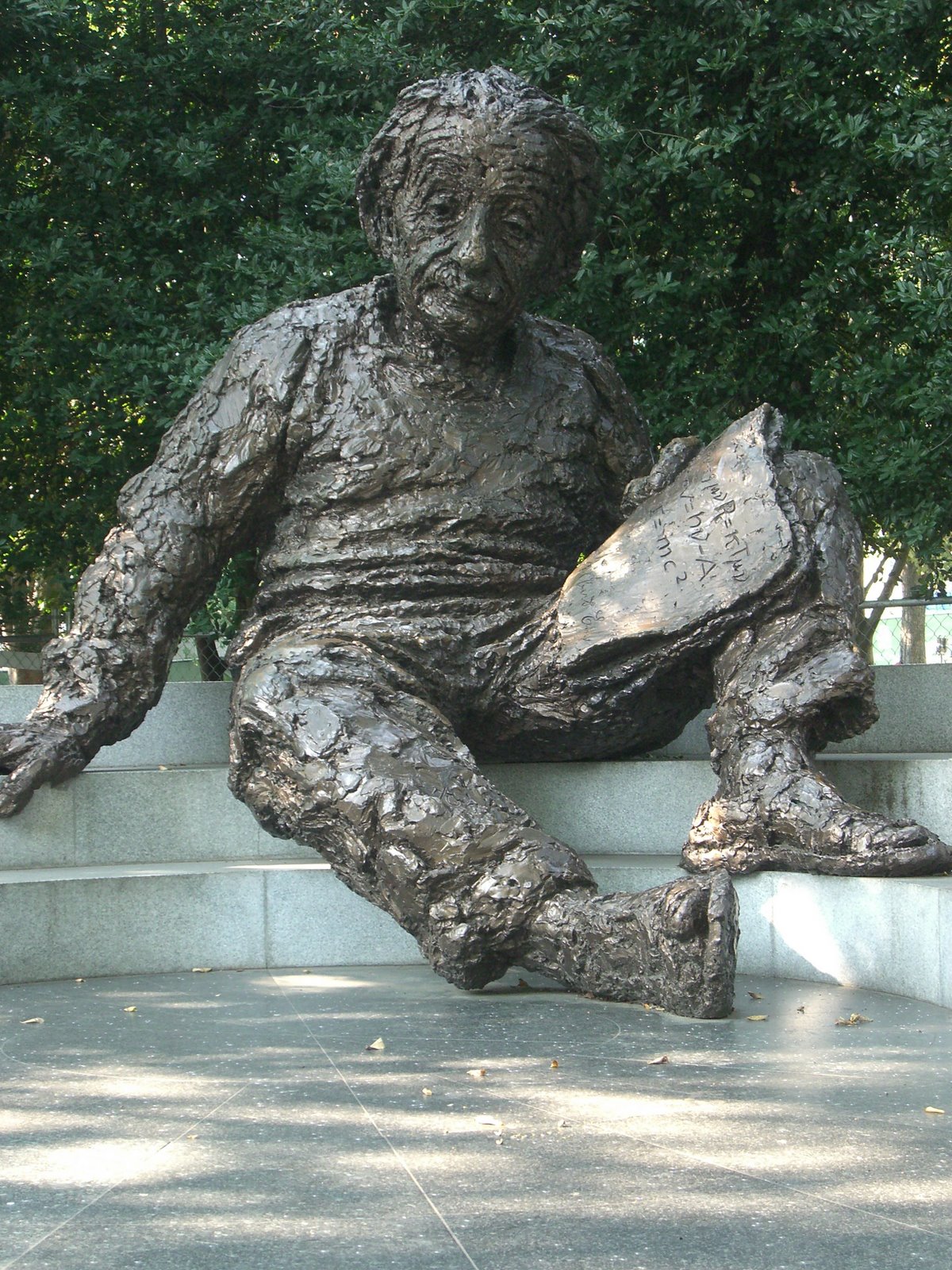
EINSTEIN'S INTUITION
After reading Isaacson's book on Einstein, which I heartily recommend, I picked up a book I took out of the library a while ago and kept renewing. It is called Einstein and the Poet: In Search of the Cosmic Man, by William Hermanns. Until Einstein came alive for me, came out from behind the myth thanks to Isaacson, I had no mental place for it.
It consists of four interviews with Einstein by Dr. Hermanns, who was initially Einstein's fellow Berliner and then his fellow exile. Hermanns is a sociologist and poet, who has strong mystical leanings and little understanding of physics. The first interview takes place in Berlin as the Nazis are gaining strength and becomes entwined with marching Brownshirts. It is both a wonderfully and terrifyingly bizarre piece, and it would make a striking movie or perhaps play.
The next three interviews take place in the United States during and after the war. Although lacking the drama of the first, they are equally informative. Hermanns continually goads Einstein to talk about things that he is not comfortable talking about, such as mysticism, and then pokes fun at his own obtuseness for continuing to press him. Nonetheless Einstein reveals a great deal to him. The interviews contain a treasure trove of information about Einstein's understanding of intuition. I thought I had the intuition bug, Einstein had it even worse!
Intuition can take many different forms. I identified deeply with a portion of what Einstein said about it. "Yes that's what it's like for me," I found myself saying with wonderment and even delight at the recognition. This kinship to some of what Einstein evoked no doubt comes from the fact that we share a personality type.
After I finished the book, I copied down some quotes I found particularly moving or informative. By putting them one after the other and pondering them a bit I came to see that they formed a coherent, profound, and provocative worldview.
Intuition for Einstein—be it about cosmic law or about predicting the outcome of the Second World War—is intimately connected with feeling. Many associate both feeling and intuition with the gut. But for Einstein, intuition is grounded primarily in the feeling of the heart—in its receptivity and its tendency to move out. It depends on a deep caring and receptivity that pushes him to go beyond what is currently known or thought or happening in order make contact with the cosmic order.
The following passage comes when Einstein and Herrmanns are talking about the Nazis and the flaw in the German national character that lead to Hitler's appeal.
It consists of four interviews with Einstein by Dr. Hermanns, who was initially Einstein's fellow Berliner and then his fellow exile. Hermanns is a sociologist and poet, who has strong mystical leanings and little understanding of physics. The first interview takes place in Berlin as the Nazis are gaining strength and becomes entwined with marching Brownshirts. It is both a wonderfully and terrifyingly bizarre piece, and it would make a striking movie or perhaps play.
The next three interviews take place in the United States during and after the war. Although lacking the drama of the first, they are equally informative. Hermanns continually goads Einstein to talk about things that he is not comfortable talking about, such as mysticism, and then pokes fun at his own obtuseness for continuing to press him. Nonetheless Einstein reveals a great deal to him. The interviews contain a treasure trove of information about Einstein's understanding of intuition. I thought I had the intuition bug, Einstein had it even worse!
Intuition can take many different forms. I identified deeply with a portion of what Einstein said about it. "Yes that's what it's like for me," I found myself saying with wonderment and even delight at the recognition. This kinship to some of what Einstein evoked no doubt comes from the fact that we share a personality type.
After I finished the book, I copied down some quotes I found particularly moving or informative. By putting them one after the other and pondering them a bit I came to see that they formed a coherent, profound, and provocative worldview.
Intuition for Einstein—be it about cosmic law or about predicting the outcome of the Second World War—is intimately connected with feeling. Many associate both feeling and intuition with the gut. But for Einstein, intuition is grounded primarily in the feeling of the heart—in its receptivity and its tendency to move out. It depends on a deep caring and receptivity that pushes him to go beyond what is currently known or thought or happening in order make contact with the cosmic order.
The following passage comes when Einstein and Herrmanns are talking about the Nazis and the flaw in the German national character that lead to Hitler's appeal.
Einstein nodded: he was a good listener. After a pause he said, "The cosmic man must be restored, the whole man who is made in the image and likeness of the arch-force, which you may call God. This man thinks with his heart and not with party dogma. As I've explained before, there is an order in the universe – a cosmic order – and humans have the possibility of understanding these laws."
Einstein leaned back in his chair; so did I,putting my writing pad on my knees. He added, "I have no doubt that the allies will win the war."
I smiled, "Oh, you are my prophet again."
"Prophet or not," he scratched his head, "what I say is more often felt through intuition than thought through intellect."
Hermanns is constantly pushing Einstein to acknowledge his inherent mysticism. He succeeds in getting Einstein to say something that probably few scientists today would say—that there is a vital force or energy in creation. Einstein is willing to associate energy with what are generally seen as spiritual concepts.
I pulled out some notes. "Once, in England, I was at dinner with people highly trained in meditation, among them Professor Suzuki who asked me to ask you if spiritual vibrations and electricity have the same original cause or force."
"I believe," Einstein answered, "that energy is the basic force in creation. My friend Bergson calls it élan vital, the Hindus call it prana."
This acknowledgment of at least certain types of energy that cannot, or not yet, be measured by instruments is noteworthy but it is perhaps not completely surprising. Einstein was responsible for showing us that matter and energy are interchangeable. He understood empiricism to be only a tool of intuition. Finally like Spinoza, he saw God, the universe, and all of life as a harmonious whole.
Einstein looked through the window and seemed to mumble more to the trees than to me, "I believe that I have cosmic religious feelings. I never could grasp how one could satisfy these feelings by praying to limited objects. The tree outside is life, a statue is dead. The whole of nature is life, and life, as I observe it, rejects a God resembling man. I like to experience the universe as one harmonious whole. Every cell has life."
He turned to me and smiled, "Matter, too, has life: it is energy solidified. Our bodies are like prisons, and I look forward to be free, but I don't speculate on what will happen to me. I live here , and my responsibility is in this world now..."
Experiencing the universe as a harmonious whole, there is no reason to fear either life or death. True religion depends only on holding the world in a receptive, caring, and judicious way—on conscience. This opens the door to intuition, which allows at least Einstein to glimpse the law conformability of the universe (and the rest of us too, although no doubt somewhat more dimly).
"The truly religious man has no fear of life and no fear of death—and certainly no blind faith: his faith must be in his conscience. Then he will have the intuition to observe and judge what happens around him. Then, he can acknowledge that everything unfolds true to strict natural law, sometimes with tremendous speed."
As a part of the cosmic order, certainly Einstein, and perhaps all of us, have a purpose which we can recognize with our intuition. Since our instructions or purpose comes from this harmonious whole, we are participating in eternity in the present.
"Indeed, it is not intellect, [which means book knowledge and empiricism for him], but intuition which advances humanity. Intuition tells man his real purpose in this life... I do not need any promise of eternity to be happy… my eternity is now. I have only one interest: to fill my purpose here where I am. This purpose is not given to me by my parents or my surroundings. It is induced by some unknown factors. These factors make me part of eternity. In this sense I am a mystic...”
As an inherent part of this totality, we are much larger than we usually experience. Einstein's religion, like Spinoza's, is that the universe is rational. The highest calling is to ponder its laws. Our usual ways of knowing are crude and cannot comprehend the coherence and beauty of the universe. Only the heart with its intuition can lead us beyond what we know of the universe and of ourselves.
Einstein leaned forward, "… it is not a religion that teaches that man is made in the image of God—that is anthropomorphic. Man has infinite dimensions and finds God in his conscience. This religion has no dogma other than teaching man that the universe is rational and that its highest destiny is to ponder it and co-create with its laws. There are only two limiting factors: first, that what seems impenetrable to us is as important as what is cut and dried; and: second that our faculties are dull and can only comprehend wisdom and
serene beauty in crude forms, but the heart of man through intuition leads
us to greater understanding of ourselves and the universe."
Although intuition is what allows us to move forward—is the most important part of thinking—it alone is not enough. Knowledge also has its place, but intuition is the gatekeeper at the most critical juncture. Even though the workings of intuition remain mysterious, it is a reality.
"Isn't truth inherent in man?" I interjected. "You once told me that progress is made only by intuition, and not by the accumulation of knowledge."
"It's not as simple as that," replied Einstein. "Knowledge is necessary, too. An intuitive child couldn't accomplish anything without some knowledge. There will come a point in everyone's life, however where only intuition can make the leap ahead, without ever knowing precisely how. One can never know why but one must accept intuition as a fact."
September 05, 2007
Wolfgang Pauli on Kepler and the Transition from Alchemy to Classical Science

When I opened my new guidebook at random, of all things, it happened to fall on a page listing an alchemical museum. I was delighted at the thought of visiting on my upcoming trip to Prague what was billed as the only alchemical museum in the world. Yet when I looked a second time I saw it was closed for the summer. Instead I had to satisfy myself with rereading an article on alchemy by physicist Wolfgang Pauli I had found very thought provoking. He uses the work of Johanus Kepler as a lens through which to view the transition from alchemy to the classical scientific perspective.
Pauli is best known for his work on the spin of elementary particles. As a particle physicist he grappled closely with the wave particle duality. He also was a patient and collaborator of Carl Jung. He worked with Jung to integrate the intuitive, imagistic, and feeling material that came through his dreams with his much stronger thinking side. Like Jung, he came to feel that both mind and matter were manifestations of the same primary material or force prior to both. The article called "The Influence of Archetypal Ideas on the Scientific Theories of Kepler" appears in a volume with an essay of Jung's on synchronicity. The book is entitled The Interpretation of Nature and the Psyche and was first published in 1955.Kepler (1571-1630) was a devout Christian with mystical tendencies as well as an important figure in the history of science. Converted to the Copernican heliocentric universe early in his career by his tutor, he became obsessed with proving that the planetary orbits were circular. He was strongly influenced by, among other things, neo-Platonic philosophy, which explored the harmonious mathema
tical relationships behind music and tried to generalize these to nature as a whole. Kepler saw the Divine in the regularity of geometry and saw the cosmos as what might be called Divine Geometry. The sphere was for him the most perfect geometric form. He felt its harmonious proportions encoded the Triune Christian God (with the Son standing for Creation), the relationship of the soul to the body, of God to the human soul, and, at least early on, of the sun to the planets. (The picture is a model of Kepler's early view of the solar system.) He thought the soul responded instinctively to the harmonies of the sphere because, as Pauli puts it, by virtue of its circular form [it] is an image of God, in Whom these proportions and the geometric truths following therefrom exist from all eternity. " Below are a few passages from Harmonices mundi, Kepler's book on "the harmony of the worlds."... the movement of a point located in the center [of the sphere] to a single point on the surface, represents the first beginning of creation, emulating the eternal generation of the Son in that the center flows out towards infinitely many points of the whole surface, which, under the rule of the most perfect equality, is formed and described by infinitely many lines; and this straight line is, needless to say, the element of corporeal form.
The point spreads itself out over this extension so that point and surface are identical, except for the fact that the ratio of density and extension is reversed. Hence there exists everywhere between point and surface the most absolute equality, the closest unity, the most beautiful harmony[literally: breathing together!], connection, relation, proportion, and commensurability. And although Center, Surface, and Distance are manifestly Three, yet they are One, so that no one of them could be imagined to be absent without destroying the whole.
...the circle beautifully fits into the intersecting plane (of which it is the circumscribed limit) as well as into the intersected sphere by way of a reciprocal co-incidence of both, just as the mind is both inherent in the body, informing it and connecting with corporal form, and sustained by God, an irradiation as it were, that flows into the body from the divine countenance; whence it [the mind] derives its nobler nature.
Alas poor Kepler, working with the careful astronomical data collected by Tycho Brahe, found that the planetary orbits are not circular. However his commitment to geometry had not failed him since he eventually was able to show that they are elliptical. He also determined that a planet swept out equal areas of its orbit in equal time periods (click for an animation of Kepler's 2nd Law. Finally he recognized the mathematical relationship between the (mean) distance of a planet from the Sun and the size of its orbit. By doing so he found a much more complex harmony in nature, which finally enshrined the sun at the center of the universe. Kepler's work was essential to the formulation of the law of gravity by Newton, who lived from 1643 to 1727.
----------
The final part of Pauli’s article explores the vitriolic controversy between Kepler and his contemporary Robert Fludd, a practitioner of alchemy.
Kepler's understanding of a rational universe ultimately grounded in the harmonies of mathematics collided with the traditional alchemical view based on a “archaic-magical” apprehension of nature in which boundaries between the real and the symbolic were completely absent. Like Kepler, Fludd understood the Divine to be reflected in the cosmos, yet much more dimly. Thus the relationship between the Divine and his creation was not harmonious for Fludd and other alchemists. They saw a cosmic struggle between form as the light principle, and matter, or darkness, which dwells in the earth. This struggle could only be redeemed by the alchemical process, which releases from matter its latent light and by the same token transforms the alchemist. The pictures below, what Fludd called "hieroglyphic figures," demostrate his view of the cosmos.

Pauli writes, "Fludd never distinguishes clearly between a real, material process and a symbolical representation. Because of the analogy of the microcosm to the macrocosm the [al]chemical process is indeed at the same time a reflection of the whole universe.... After the withdrawal of the formal light principle matter remains behind as the dark principle, though it was latently present before as a part of God…. In the middle, the sphere of the sun, where these opposing principles just counterbalanced each other, there is engendered in the mystery of the [al]chymic wedding the infans solaris, which is at the same time the liberated world soul."

Quantitative measurement has no role in, and was indeed a threat to, Fludd's understanding of the universe. Pauli quotes Fludd's spirited attack on Kepler's Harmonicies mundi and defense of the alchemical approach.
...What he has expressed in many words in long discussions I have compressed into a few words and explained by means of hieroglyphic and exceedingly significant figures, not, to be sure, for the reason that I delight in pictures (as he says elsewhere), but because I…had resolve to bring together much in little and, in the fashion of the alchemists, to collect the extracted essence, to reject the sedimentary substances, and to pour what is good into its proper vessel; so that, the mystery of science having been revealed, that which is hidden may become manifest; and that the inner nature of the thing after the outer vestments have been stripped off, may be enclosed, as a precious gem set in a gold ring, in a figure best suited to its nature---a figure, that is, in which its essence can be held by eye and mind as in a mirror and without many-worded circumlocutions.
For it is for the vulgar mathematicians to concern themselves with quantitative shadows; the alchemists and Hermetic philosophers, however, comprehend the true core of the natural bodies.
...I contemplate the internal and essential impulses that issues from nature herself; he has hold of the tale, I grasp the head; I perceive the first causes, he its effects.
Kepler answers:
If you know of another mathematics (besides that vulgar one from which all those hitherto celebrated as mathematicians have received their name), that is, a mathematics that is both natural and formal, I must confess that I have never tasted of it, unless we take refuge in the most general origin of the word...and give up the quantities. Of that, you must know, I do not speak here. You, Robert, may keep for yourself its glory and that of the proofs to be found in it---and how accurate and how certain those are, that, I think you will judge for yourself without me. I reflect on the visible movements determinable by the senses themselves, you may consider the inner impulses and endeavor to distinguish them according to grades. I hold the tale but I hold in my hands; you may grasp the head mentally, though only, I fear, in your dreams. I am content with the effects, that is, the movement of the planets. If you shall have found in the very causes harmonies as limpid as are mine in the movements, then it will be proper for me to congratulate you on your gift of invention and myself on my gift of observation---that is, as soon as I shall be able to observe anything.
Pauli points out that Kepler, a transition figure, overstates the empirical impetus behind his ideas. Pauli is also unwilling to side completely with the quantitative mode that Kepler defends, lamenting what was lost in the transition to the classical science that was to come. (Even thought Newton was a devoted alchemist, he kept his scientific work and writing separate from his alchemical concerns.)
Whereas as Kepler conceives of the soul almost as a mathematically described system of resonators, it has always been the symbolical image that has tried to express, in addition, the immeasurable [emphasis added] side of experience which also includes the imponderables of the emotions and emotional evaluations. Even though at the cost of consciousness of the quantitative side of nature and its laws, Fludd’s "hieroglyphic" figures do try to preserve a unity of the inner experience of the "observer" (as we should say today) and the external processes of nature, and thus a wholeness in its contemplation....
Pauli felt psychology as well as physics was beginning to bridge the gap between the quantative and qualitative that Kepler's work helped bring about. My sense is that more than 60 years after Pauli's article, this important coming together of the quantitative and the qualitative is still just beginning.
May 01, 2007
INTUITION AND BRUSSELS SPROUTS---WHAT!!?
Julia became my cooking teacher. Her clear and wonderful, if labor intensive, recipes produced food I was delighted to serve and eat. Because she provided such a strong base, she created what I will call a feeling for the palate--- or alternatively, for the recipe.
Her last direction was frequently to correct seasoning. Often it seemed that if I held the salt (or spice) shaker over the dish and went into a mentally blank but extremely attentive place, I would know exactly how much to put in. It certainly doesn’t happen all the time, but when it does, I have this clear crisp feeling of being on beam—almost as if I am communing with the dish.
Over the years I have consulted Julia less and less. A recent special project made me go back to her once again. I ate a wonderful pasta dish in a restaurant several years ago, which, among other things, contained a few brussels sprouts. Cut in two, they had been browned in such a way that they became all crispy on their cut end. The contrast of textures and tastes was divine.
Eventually, I decided I wanted to try to make them for myself. I have cooked brussels sprouts
The key, Julia said, was a huge pot of boiling water, a short cooking time---about 6 minutes---and taking them out at their greenest. When I tried it, they turned bright green in no time at all---maybe two minutes. I hesitated a moment and then took them out.
I went on to the second step—cutting them in half and trying to brown them in butter. They hardly browned at all. However my curiosity was piqued. I thought intuition might tell me how brown the butter had to be---instead of my conditioned reactions of all kinds, combined with my thinking mind. Over a period of months I cooked many batches of brussels sprouts—each time trying a different way to brown them. Indeed intuition did have the role in this project, and somewhat like I anticipated, but I got in which part wrong.
I began to notice something interesting about the initially cooking step---the sprouts stayed bright green for a while---maybe as long as a minute and a half. Nonetheless something in me knew when they were at their brightest green and would be at their most delicious. This means a tiny bit crunchy inside, with a wonderful mustard or perhaps horseradish-like flavor.
I would watch them attentively and all of a sudden I would just know it was time to take them out. It certainly had nothing to do with thinking. In fact when I let myself think, I was less alert to this other kind of knowing and less likely to respond appropriately.
When I was a postdoc---way before I began to study intuition---I had my first experience of “knowing more than I know.” Often before I went home for the evening, I would have to add a liquid sample to a thick slurry of beads in a column and wait until it very slowly flowed in. Often it would get stuck.
One evening I knew that the sample was flowing even though I realized that the change in the fluid level in the column above the slurry of beads was imperceptible to my conscious mind. Astounded, I checked several more times and came to the same conclusion. This knowing had an extremely grounded, even physical feeling to it, though I could not identify its source.
I sensed it was not extraordinary knowing, but something every bit as interesting. Apparently our ability to detect visual change below awareness is greater than our ability to detect visual change at a conscious level. Since then I have become familiar with an ever growing body of work that confirms that indeed the unconscious can register and integrate stimuli that do not make it to awareness---see, for example, this 2000 review article by Philip Merikle . The study of unconscious perception of all kinds is a hot area of investigation in cognitive science.
I suspect there is also a similar explanation for my ability to sense when the brussels sprouts will be at their most flavorful as well. Probably my unconscious is aware of gradations in bright green that my conscious mind cannot distinguish. It may also follow the rate of change of the color to capture when it is at its brightest.
Perhaps there is a similar type of physiological explanation for my sometimes ability to stand over the pot in an apparently blank but attentive way and know just how much salt to put in---and also to get a clear signal that it is so. Could the vapors above the pot contain essential clues?
Of course I cannot rule out that an even more obscure aspect of the human ability to know has a role in this situation---or indeed any of these situations. But at least with the first two, a reasonable sounding explanation based on the greater acuity of our unconscious perceptual abilities makes it unnecessary to go any further, at this point anyway.
Currently I am still working on the second step---browning the brussels sprouts. After trying everything I could think of---different degrees of brownness of the butter, different pans, oil instead of butter, dipping the ends in different flour
This time they browned beautifully. After sitting a bit, they were scrumptious. The tangy, moist, fresh, mustardy sprouts contrasted in a profound way with the rich, deep, dark, taste of the burnt ends.
But alas they are still not really crispy. I guess I will have to go through everything I already tried before---this time with the paper towel drained sprouts. It is hardly a burden, but a labor of culinary and gustatory love.
April 01, 2007
Betraying Spinoza
The 17th century philosopher Baruch Spinoza counseled that we strip ourselves of our attachment to our personal identity and instead use reason to take our place as citizens of the cosmos. Contemporary philosopher and novelist Rebecca Goldstein betrays Spinoza in her book Betraying Spinoza by considering how the environment he grew up in influenced his philosophical views. She also betrays Spinoza by telling something about the unusual circumstances in which she first encountered him. I will also betray Spinoza. To begin with, my knowledge of his work is secondhand. Yet it has affected me profoundly.
The loss of individual identity, of subjectivity, advocated by Spinoza leads to what Goldstein calls radical objectivity. This objectivity is different from what, rightly or wrongly, is today taken to be the objectivity of science. Spinoza’s worldview is framed by reason, yet there is a strong ecstatic, or blissful, impulse it. (In fact the word ecstasy originally meant to stand outside oneself.) Goldstein sometimes pegs his views as ecstatic rationalism.
Baruch Spinoza grew up in a community of Portuguese Jews who had escaped from the inquisition and moved to Amsterdam where they were free to practice Judaism. A brilliant yeshiva student, who also read widely, he came to reject the rigidity of traditional practice and doctrine, and especially the notion of the Jews as the chosen people. His ideas eventually led to his excommunication. Goldstein traces how the spiritualized rationalism of Talmudic debate (a way of “meshing with the Devine” by studying his laws) and the Kabbalistic, or Jewish mystical tradition (strongly influenced by the Greeks) joined together with the recent suffering of the Jews at the hand of the inquisition to influence his philosophy. She says:
I have long thought that the distinctly platonic tone of Spinoza's philosophy, which consist not so much in his actual picture of reality but in the ecstatic impulse that radiates it, and that sharply distinguishes his rationalism from both Descartes' and Leibniz’s came to him by way of the kabbalistic influences which were vividly alive in his Portuguese community. And Spinoza's system will offer us, as we shall see, its own solutions to the two mysteries that the most central to kabbalistic speculations; the ontological mystery of why the world exists at all, and the ethical mystery of suffering; why does suffering---and of such mind-numbing magnitude---exist in this world, if God is both all good and all-powerful? (p. 91)
Although Spinoza suggests the key to avoiding suffering is to enlarge one's frame of reference to include all of creation, his views are grounded in bodily experience and in subjectivity. He wrote, “The endeavour, wherewith everything endeavours to persist in its own being, is nothing else but the actual essence of the thing in question.” ( The Ethics , Part III. VII, quoted in Goldstein p. 161) We come into being in a body and are committed to the well-being of this body in a way we are committed to nothing else. We cannot help it.
This basic yet nonetheless curious fact is at the core of most experience. It is what Spinoza calls conatus. Our emotions, bestowed on us by evolution to assure that we survive, make it so. Antonio Damasio, an emotion researcher, in his book Looking for Spinoza, points out that Spinoza anticipated much of current thinking in cognitive science. Damasio, for example, has amassed a great deal of neuroanatomical and clinical evidence that places the body and its emotions at the very core of the experience of self. Goldstein writes:
One cares about oneself simply because one is one’s self. A person is committed, immediately and unthinkingly, to the survival and flourishing of a single thing in the universe that she is. There is no reason, external to one's own identity with that thing--- one self --- that one should be so single-mindedly, unswayingly committed to it. What explains this commitment is nothing over and above the bare fact that one is who one is. (p.160)
When we are happy, this body and the experience of self that come with it seems to expand. When we are unhappy it seems to contract into itself. Our biological mandate, which we cannot refuse, is to try to expand this self as much as possible. Yet our emotions are shaped, or conditioned, by our background and also triggered by external circumstances. They are thus doubly contingent on things we cannot control. Spinoza argues that the only way to assure success in our commitment to ourselves is to greatly enlarge our point of view. We suffer less to the extent that we can distance ourselves from our own emotions. Goldstein says:
That problematic and precious “I” is, for Spinoza a symptom of a passivity, the acceptance of the contingently given, that weakens our capacities, drains and us, impedes our driving force to persist in our own being, to flourish in the world. Paradoxically the only way to flourish in one’s being is to cease being only that being.(p. 69)
Our very essence, our conatus, will lead us, if only we will think it all through, to a vision of reality that, since it is the truth, is in our interest to attain, and will affect such a difference in our sense of ourselves that we will have trouble even returning to the pre-philosophical attachment to ourselves.(p.162)
I had an illuminating experience while reading Goldstein’s book. Just as I was getting ready to go to the airport for my flight home from a trip, I checked my email and received some unanticipated bad news. A deeply unpleasant incident occurred on the way to the airport as well, in part because I was completely occupied processing my thoughts and feelings.
I arrived at the airport in a state of psychic shock. After stewing in my feelings for a while more, I felt drawn to reading Goldstein’s book; I read straight through to Boston. When I arrived home, my emotional pain had not gone away: it was a deep ache in my chest. Yet I was now able to accept these unpleasant events and the internal discomfort they caused without judgment. This seemed to free my mind from its tendency to process seemingly endlessly deeply upsetting events.
Spinoza’s pragmatic if challenging solution to the question of human suffering meets another strand of his philosophy. His basic assumption is one of holism. He begins The Ethics with the following definition,“By that which is self-caused, I mean that of which the essence involves existence, or that of which the nature is only conceivable as existent." (The Ethics, Part I, I, in Goldstein p.71) The universe causes itself. It is therefore deterministic, even if we with limited minds can not understand it. The universe defines logic, or as Goldstein says, it is logic self-aware.
But this reality is not the material world generally perceived by the senses. Sense experience is the lowest step on Spinoza’s hieracrchy of cognition; he calls it imagination. Rather reality is the web of rational necessary connections that underlie the cosmos. By forsaking personal identity, and using our reason, we can partake of this web of necessary connections of which we are, at least in our essence, inherently a part. Though this logic is something we can only fully experience with intuition, our reason prepares us and guides us to this knowledge of God with Nature---deus sive natura.
I had another experience that helped illuminate the power of Spinoza’s work. One morning after spending about an hour with my notes from Goldstein's book in preparation for writing this article, I went outside to go to my car. The shimmering light and my hour with Spinoza seemingly came together to allow me a taste of something extraordinary, which might have some relationship to the ecstacy associated with nature for Spinoza. This feeling came neither from the sensory details themselves, nor how they fit together. Rather it came from something intangible behind all this. Whatever it was seemed dazzlingly intelligent (though whether it was was rational, and thus conceptual, or non-conceptual, I do not know). In any case, the world appeared both material and immaterial, and I found myself soaring to the rhythm of the pulse between the two.
For the next several hours, whenever I turned from my work I could reconnect to this ecstatic feeling. (Even now when I extend my field of vision to its limits, I can recapture a faint echo of the feeling.) But later in the afternoon I came down hard.
A friend’s manipulation about something unimportant and my acquiescence in order to minimize the situation and avoid a showdown left me internally fuming. My effort to talk myself down and to distract worked only to an extent. It did not really get inside to the source of my intense reaction, and I could not completely put this reaction aside. Alas, even though I had tried not to betray Spinoza and myself, I ended up betraying us both.
I plan to read Spinoza’s books, even though their sparseness and rigor makes them daunting. I would like to get a more of a feeling for this web of necessary connections Spinoza calls reason and also how reason and intuition come together for him. Even more importantly, I hope his methodology---his bare bones rationality---in conjunction with his message, will help me become more immune to the seductive and tenacious pull of negative emotions (even when it is round about).
Although I tend not to think this way, I am aware that there may be a bonus. Actually my preference is for super-grounded experiences of altered consciousness rather than ecstatic ones. But hey, if it ever gets to be a real issue, maybe I can work something out.

Rebecca Goldstein, Betryaing Spinoza: The Renegade Jew who Gave Us Modernity (New York: Schocken Books, 2006).
Antonio Damasio, Looking for Spinoza: Joy, Sorrow, and the Feeling Brain (New York: Harcourt, 2003).
Subscribe to:
Posts (Atom)