I recently published a book titled Understanding Intuition: A Journey In and Out of Science. It explores some foundational intuitions about intuition I experienced and brings them together with a deep dive into the science of intuition. It took me years to write and find a publisher. All told, it was a 2-decade long endeavor. Early in 2018, Academic Press, an imprint of Elsevier, a scientific publisher, issued the work.
February 17, 2019
To Publicize or Not: Is That The Question?
I recently published a book titled Understanding Intuition: A Journey In and Out of Science. It explores some foundational intuitions about intuition I experienced and brings them together with a deep dive into the science of intuition. It took me years to write and find a publisher. All told, it was a 2-decade long endeavor. Early in 2018, Academic Press, an imprint of Elsevier, a scientific publisher, issued the work.
July 27, 2008
EMERGENCE AND POTENTIAL SPACE
The word "Emergence" has intrinsic appeal. It immediately leads beyond itself---to a space of potentiality. The world is wide open after that final "e"---or at least sort of. For the most part emergence is evoked after the fact. I hope to look a little more at the space beyond the final e, but first things first.
Emergence provides a way to account for the development of higher life forms and even spirituality without requiring a master plan or planner. Emergence oversimplified means that the whole is greater than the sum of its parts. A portion of its appeal is it provides an alternative to the reductive perspective, which holds that higher levels can be completely explained by lower levels. Thus biology can be completely explained by chemistry and chemistry in turn by physics. Emergence in contrast says that novel properties can appear at higher levels that are essential to complete understanding. It implies there is always something new under the sun---or rather the potential for something new is always there.
I work together on a science and spirituality blog with a Brandeis undergraduate that we call The Bridge: A Science and Spirituality Resource. I took on the task of summarizing an intriguing but challenging article by Terrence Deacon for the blog entitled “Emergence: The Hole at the Wheel's Hub.” At the end of my second time through the 40 page paper I had one of those experiences in which science and spirituality really converged for me. The moment of insight intensified during several subsequent readings. It marked a considerable deepening of my morning meditation and perhaps other aspects of my spiritual life as well.
The primary purpose of Deacon's article was not spiritual, but instead to impart some order to the promiscuous concept of emergence by characterized three different levels. However he brings all three together under the Eastern-seeming concept of absence, a potential shaped by what is not there. He quotes from the Tao Te Ching
Thirty spokes converged at the wheel’s hub to an empty space that makes it useful. Clay is shaped into a vessel, to take advantage of the emptiness it surrounds. Doors and windows are cut into walls of a room so that it can serve so some function. Though we must work with what is there, use comes from what is not there.
First something about the basic idea behind emergence. Thermodynamics tells us that the universe is running downhill and becoming increasingly random. In a state of randomness a change in one direction is balanced by change in the opposite; everything cancels everything else out. How then is life possible, to say nothing of the purposefulness on which we humans so pride ourselves? After all, we are---including our minds---part of nature.
The answer is that the way things fit together---relational properties---instead of a canceling each other out, may, depending on a confluence of events, build on each other. These relational or configural properties are responsible for the spontaneous production of order, such as the formation of whirlpools and also the origins of life. They explain why our organism can turn over most of the physical material it is made of and nonetheless persist.
Deacon’s three levels of emergence represent three critical transitions in the organization of matter. At the first level, higher order properties can emerge when separate elements become an aggregate. (These phenomena can be explained reductively, but including this level provides a complete sweep of the terrain.) For example, when H2O molecules aggregate, the properties of liquidity emerge. Becoming a liquid gives rise to characteristics such as surface tension and different kinds of flow that depend on the molecules’ relationship to each other. Not only H2O but many different kinds of molecules can become liquids. The characteristic behavior associated with liquidity, its “laws,” then become a higher level description of these systems.
The second level transition describes the emergence or self-organization of form. Here first-order emergence becomes unstable. An example is a Benard cell. When a shallow pan of water or other liquid is heated evenly from the bottom, hexagonal convection cells emerge. All different kinds of convection patterns occur initially but they cancel each other out. Only the hexagonal cells survive because their close packing is most efficient at bringing the heat to the surface.The emergence of form occurs when random fluctuations at a lower level---here water molecules rising to the surface to remove the heat---give rise to relational regularity at higher levels that are beneficial to the system. These beneficial regularities in turn influence the lower levels to support this arrangement---the two work together so only hexagonal cells form. The kind of causality that occurs in these self-organizing systems is decidedly circular. As Deacon puts it, “interaction dynamics at lower levels becomes strongly affected by regularities emerging at higher levels of organization.”
Another example of a self-organizing system is the spontaneous generation of autocatalytic sets. Heterogeneous molecules form together into a cycle where, for example, A catalyzes the formation of B, B catalyzes the formation of C, and C of A. These cycles are very important in cellular metabolism. All that is needed to keep them going is the availability of raw materials and an energy flow through the system.
Check out this video which shows a very sexy autocatalytic cycle called a Belousov-Zhabotinsky Reaction.
With the third transition, some sort of informational memory is present, for example genetic material. This allows emergent forms to be reproduced over and over again. Think of it like a franchise with loose corporate control. Reproduction can then occur over time and even space. This memory is what makes development and evolution possible and by the same token gives a history to the system. The ability of self-organizing forms to reproduce---so their occurrence is no longer dependent on spontaneous self-organization---is arguably where life begins. These systems have a purpose of sorts---to reproduce and undergo change that enhances the possibility of not being canceled out.
These higher-level emergent systems are shaped by absence in several different ways. They are forged not by design, but by what is not canceled out. The forms that arise and then reproduce depend to a large extent on factors external to them, such as their fit with environmental conditions. Life and the mind to which it has given rise---in part because this passive selection goes on---is ever governed by the 'pull of yet unrealized possibility.'
Here is the passage close to the end that showed me how deeply this paper---which at that point I at best barely understood---had gotten to me.
Like something coming out of nothing, the subject of self is, in effect, a constitutive absence for the sake of which new constitutive absence is being incessantly evolved. In this sense, there is some legitimacy to the eliminativist claim that there is 'no thing' that it is. Indeed this must be so. The locus of self is, effectively, a negative mode of existence, that can act as an unmoved mover of sorts: a non-thing that nonetheless is the locus of a form of inertia---a resistance to change--- with respect to which other physical processes can be recruited and organized.
When I read that (the second time through) I had one of those powerful moments of knowing in which I could capture only a little of what was being known. As a student of intuition I suspect these are the best kind. I any case I am happy my unconscious was doing its job.
I felt myself to be a mere input/output tube. There was an intense focus of energy around my mouth, one of the ways into or indeed out of the devise. I enjoyed the minimalism and cleanliness of sensing myself as nothing more than this tube and the energy that served as its gate---of being largely without a self for an instant.
It was an experience of spiritual absence or emptiness, but not the kind of spiritual emptiness that verges on transcending the physical realm. Rather it was an emptiness that was pregnant with the most elementary aspects of human life---of feeding and of speaking, which lent it a hearty, almost animal-like vitality. It was also pregnant with everything I was not worrying about that would take care of itself. Finally it was pregnant with all that would flow through me and I might take in and perhaps transform. I felt very simple and very free. There was just potential space.
June 26, 2008
What is Real? Quantum Physics for Real Dummies
Let's warm up with this one. Do you know how radio works? I can't say I really do but I know this. Signals from a radio broadcast, like any other electromagnetic signals, are waves that travel in the atmosphere. Somehow recording a radio show sets a series of electromagnetic waves in motion that radiate out into space. They can be picked up by radios in the viewing area tuned to waves of that frequency. So all of space is packed full with electromagnetic waves, some from Garrison Keillor, some from Adolph Hitler, and some from the Big Bang.The first time I really comprehended this I found it freaky. I was reading a book by the physicist Richard Feynman, who was my hero at the time. There I was being bombarded by waves of all kind carrying heavens knows what.
It helped me begin to understand a very strange experience I had a number of years before. One night my stereo tuner, which was turned off, started broadcasting music. It seemed to be coming from the back---from one of the connections. I thought the house was inhabited by ghosts. Why it happened then and only then is beyond me.
So much for the warm-up---which is actually a bit of priming. Here comes the quantum physics. Our physical experience is dominated by objects that have more or less clear boundaries, that are separate from each other. Also causality reigns. If I so choose, with my arm I can knock the folder next to my computer off my desk. This follows the laws of classical physics.
But at the quantum level, the level of subatomic particles, most physicists think that it is all chance and randomness. Probabilities rather than certainty or causality are supposed to rule. It is only when an observation is made that the function that determines these probabilities, the wave function, is said to collapse into a specific state. Before that all possibilities are said to coexist or are superimposed.
I highly recommend this video. It is a very clear presentation of the famous double slit experiment that helped demonstrate the very strange things that happen at the subtle atomic level. It is also very entertaining--- worth watching just to enjoy Dr. Quantum's facial expressions!
Not everyone was happy with the randomness that the usual interpretation of quantum mechanics enshrines at the core of reality. Einstein famously said, "God does not play dice." He was not willing to give up the elegant determinism of classical physics. So he proposed that there must be hidden factors, what he called hidden variables, which really control events at the quantum level.
In the 1930s, along with some colleagues, Einstein devised a thought experiment to show that the usual understanding of quantum mechanics is incomplete. It pointed out a paradox. If particles are governed by chance, then some of the predictions of quantum theory would also indicate that particles far apart from each other do not always behave independently. This would be like twins halfway around the universe instantaneously affecting each other. The notion that particles widely separated in space could communicate instantly is extremely problematic because it violates Einstien's own dictum that the speed of light is the fastest any information can travel. Einstein argued that this indicated that the irreducible randomness or chance quantum mechanics seemed to suggest at the base of everything also had to be wrong.
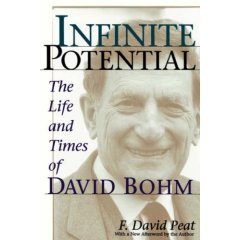
A younger colleague, David Bohm, in the 1950s became interested in developing a deterministic understanding of quantum mechanics. He did not like that the usual interpretation had no underlying theoretical framework. A strongly intuitive physicist, he favored models he could picture or experience at some level. Like Einstein, he also thought it impossible that information could travel instantaneously between particles--- or faster than the speed of light.
His answer was a model in which a quantum potential guides the behavior of particles in a deterministic but holistic way. (Bohm's work built on an earlier attempt by Louis de Broglie in the 30's to provide an alternate explaination.) For example the quantum potential tells the electron whether one or two slits is open--- see above video---and guides it so the observed results occur. The quantum potential is able to this because it contains what Bohm called “active information” about the entire system. In effect, it allows the particle to “just know” the big picture.
Meanwhile in the 60s another physicist named John Bell , influenced by Bohm, proved theoretically that to extend determinism to subatomic particles would necessarily imply what has come to be called non-locality---that particles far apart from each other would have to be connected or communicate at faster than the speed of light . (This is what Einstein could not accept, but 3 decades later it didn't bother Bell) In the 1980s a French team led by Alain Aspect demonstrated non-locality by performing an experiment proposed by Bohm and Bell (based on Einstein's initial thought experiment). Non-locality is sometimes called quantum entanglement, and it is now well accepted by physicist. In fact efforts are underway to exploit quantum entanglement technologically.
Bohm eventually proposed another whole realm, what he called the implicate order, as the source of the quantum potential. In the implicate realm, the two twins halfway around the universe from each other are actually connected. The implicate realm is unfolded or smeared out throughout our level of reality, what Bohm called the explicate order---like those radio waves that somehow caused my turned-off radio to broadcast music. He often used the idea of a hologram, in which every part contains an image of the whole to capture the relationship between the implciate and the explicate realm. But a hologram is static, whereas he saw the process of unfolding and enfolding between the realms going on continuously. He called it holomovement. To get a better sense of his ideas, check out this interview with Bohm.
This talk of other realms did not endear Bohm’s work to mainstream physics. To add insult to injury, he worked closely with the Indian teacher Krishnamurti for many years. Nonetheless a small number of physicists preferred his causal or ontological model and have worked to refine and extend it. It is now called Bohmian mechanics.
Even though the quantum potential reinstates causality, it leaves us with a universe very different from the commonsense world we experience. ( It is important to point out that none of this affects the laws of physics at the macroscopic level, but rather our picture of the subatomic realm.) In what we generally call objective reality, distant objects only affect each other when a signal of some sort, a communication, travels between them. To rescue locality as well as causality the way we usually think of them, like Bohm, we have to accept another level of reality where distant particles really are close together.
This is quite a trade-off! At the same time there is something that rings true about this situation. I mean this in the sense that things very often do seem to turn into their opposites. In any case, all us dummies can take comfort in something Richard Feynman said, "I think it is safe to say that no one understands Quantum Mechanics."
So far there has been no way to test Bohmian mechanics against the usual interpretation of quantum mechanics that claims that randomness rules. Just recently some preliminary data about the density of the early microwave radiation left over from the big bang seems to support Bohmian mechanics---according to Antony Valentini (also see first reference below and very end of post). If it is confirmed, it will cause quite a stir!
Additional Web Information:
Written in the skies: why quantum mechanics might be wrong, 2008, Nature On-Line (It is limted access, but important so I've reproduced the critical paragraphs below).
Quantum Randomness May Not be Random, 2008, New Scientist
David Bohm and the Implicate Order, by David Pratt
Do Deeper Principles Underlie Quantum Uncertainty and Nonlocality? 2005, Science
Interesting short video about the early history of quantum mechanics
&&&&&&&&&&&&&&&&&&&&&&&&&&&&&&&&&
Written in the skies: why quantum mechanics might be wrong
Published online 15 May 2008 Nature doi:10.1038/news.2008.829
Zeeya Merali
'snip'
Almost all measurements of the cosmic microwave background seem to fit well with the predictions of quantum mechanics, says Valentini. But intriguingly, a distortion that fits one of Valentini’s proposed signatures for a failure of quantum mechanics was recently detected by Amit Yadav and Ben Wandelt at the University of Illinois at Urbana-Champaign (see 'Deflating inflation?'). That result has yet to be confirmed by independent analyses, but it is tantalizing, Valentini adds.
“It’s far too early to say that this is definite evidence of a breakdown in quantum mechanics — but it is a possibility,” he says.
Hiranya Peiris, an expert on the cosmic microwave background at the University of Cambridge, UK, is impressed by the new work. “This is a pretty cool new idea,” she says. “Nobody has ever thought of using the cosmic microwave background to look into really fundamental quantum questions — cosmologists just assume that quantum mechanics is correct,” she says.
But Peiris adds that Valentini must now come up with more detailed predictions about the types of distortion that will arise in the cosmic microwave background to convince cosmologists that they are really caused by a breakdown of quantum mechanics. “He has thrown some really exciting ideas out there, but now he needs to do the nitty-gritty calculations,” she says.
June 25, 2008
April 21, 2008
ANOTHER SLANT ON CONSCIOUNESS: Vulnerability, Presence, and Power

I knew I had to write about this, yet it is a challenging topic. On the face of it, vulnerability isn't power, its weakness. It's a bit like claiming that up is down. I had only a sketchy, nonverbal sense about why I felt so strongly that this conventional wisdom is wrong.
Then I attended a seminar at the Women's Studies Research Center, where I work, by my colleague Hilde Hein, a philosopher who studies museums. During her talk she presented a double analogy she had used years ago in a talk on aesthetics. She showed on one side of the screen a picture of a proud aggressive looking nail and on the other a more humble sewing needle just entering some fabric. Below is her eloquent description of these different implements, taken from her early paper. She writes that both are employed, “…to bind together diverse substances, both [are] progenitors of socially significant structures." You will have no difficulty knowing him from her.”

He is strong, rigid, and straight, with a point at one end, the better to penetrate resistance substances, and a strong head at the other. A few sharp and well directed strokes fix him firmly in place....He remains there, stalwart and unyielding until the material that he punctures softens and rots away and he himself becomes brittle and rusted. She, by contrast, is pliant, sleek and tapered, her purpose integrated continuously throughout her form, which is, however distinctively marked by a hole at one end. A thread, introduced through that orifice, is carried distributed and left behind to hold together and shape a unity out of separate fabrics, which, once joined,live out their collective identity long after she has passed to be of service elsewhere.

This fable of gender difference intrigued me---the commanding authoritarian male who actively maintains structures with iron force as opposed to the more generative female whose nurturing guidance leaves only an inter-psyche thread. I found myself thinking about it when I woke up the next morning and sensed that this was a way into what I wanted to say. Among other things, its truth/ non-truth quality---its aptness along with its limitations as a caricature---captures the ambivalence I feel about framing this issue through a gender lens.
In her paper Hilde focuses initially on the different kinds of artifacts and then art each produces. I will focus only (and only briefly) on the different kinds of sheltering each provides for us. The strong proud nail is essential to the outer boundary layer that separate us from the environment--- our building and houses. The more humble and well traveled needle is essential to creating a boundary layer closer in--- our clothing.
Yet we humans, both male and female, are made of the softer penetrable stuff on the outside at least. The boundary of our body with the external world, our skin and flesh, is soft and permeable like cloth. Because of this we can experience the kiss of a young spring breeze on our face and the joyful effervescence of bubble bath. Of course it also means we wound and tear. To keep out infection and to heal, we have to be sown together, with needles---and nowadays disappearing thread.
We are no crustaceans separated from the world by a hardened shell. Instead the tougher stuff, the more rigid part of our body, our bones, are hidden inside. When they break or fracture, nails---or even mental plates---may be required to keep them in place and maintain the integrity of our skeletal structure.
We are made to be permeable to the external world and to each other. (In fact what are called mirror neurons in our brain make us mirror the feelings of others even when we are unaware of doing so.) To the extent that we experience and reveal our inherent vulnerability, we paradoxically reveal the stronger stuff inside. When Hillary's face revealed her vulnerability when her opponent came over to her podium in a debate during her first Senate campaign demanding she sign a statement, she seemed not only more likable, but stronger and more resilient. We saw the bones of her Being. This moment of being seems to have been the turning point in the race.
When we defend against external forces we don't like and the feelings they bring up---something alas we all do---we pretend we can maintain ourselves inviolate. Like George Bush we hold the line and become the decider of what we will let in and what we will keep out. Instead of feeling our vulnerability to the vicissitudes of life and fate, we turn it around and preemptively---and/or indiscriminately---kick ass. (The more openly vulnerable the target, the better to deflect our own banished feelings.) Instead of strength, we show meanness or bravado. Instead of letting life reveal the bones of being human, we try to stage manage it so it becomes an endless photo op.
The truth is we can't keep out difficult feelings, and perhaps especially painful vulnerability. It is inherent in the curse and gift of consciousness. Even if we try to deflect them by projecting them outward and making sure others feel them instead, they still leave their mark on us---in our muscles and maybe even our bones. In some real sense we store the unpleasant feelings we wish to keep out inside our bodies. (Remember the old saying that you become what you resist.)
My chiropractor tells me that like muscles, bones can hold tension. I'm not completely sure how this works; it could be that bones can store blocked Ch'i, or life force. In any case, the muscles that hold the bones in place have to maintain tension to do their job. I suppose as a result they can hold a certain amount of unnecessary tension as well. Difficult feelings we refuse to feel also can be stored in the patterns of reaction of muscles, including presumably the muscles that hold the bones. Whatever the mechanism, unfelt feelings tend to make our bodies function in a rigid and stiff or otherwise maladaptive way---the very opposite of the resilience and flexibility we all desire.
Experiencing vulnerability is not the same as feeling victimized. Nor does it mean taking to heart what another is saying or doing. Being vulnerable in the sense I am using it means fully feeling whatever is happening and letting it reverberate through the bones of one’s being. What I found so magnificent about Hillary in the debate in her first Senate race I described above was that she was completely present to that difficult moment.
This is a more difficult task with a backlog of stored trauma, as many of us have, or just stuff. But it is not impossible, just more of a challenge. The trick, it would seem, is to be completely permeable. This means feeling whatever is happening, remaining present as it reverberates through both our bodies and our being as long as it needs to, and then letting it pass out through the other side.
This ability to be fully present in the moment---and the next moment and the next moment--- feeling one's vulnerability to the external world and whatever it brings and brings up, links vulnerability not only to presence, but to real power. In difficult situations, correct action---actions which will serve others as well as the self---can only come from being present to what is happening as it echoes through our being before it goes out the other side. This is true whether it calls for the forceful structuring of the nail, the more gentle guidance of the needle, or something in between. No doubt we will often get it wrong, but with the effort to stay conscious, perhaps we can get it right much more of the time.
November 18, 2007
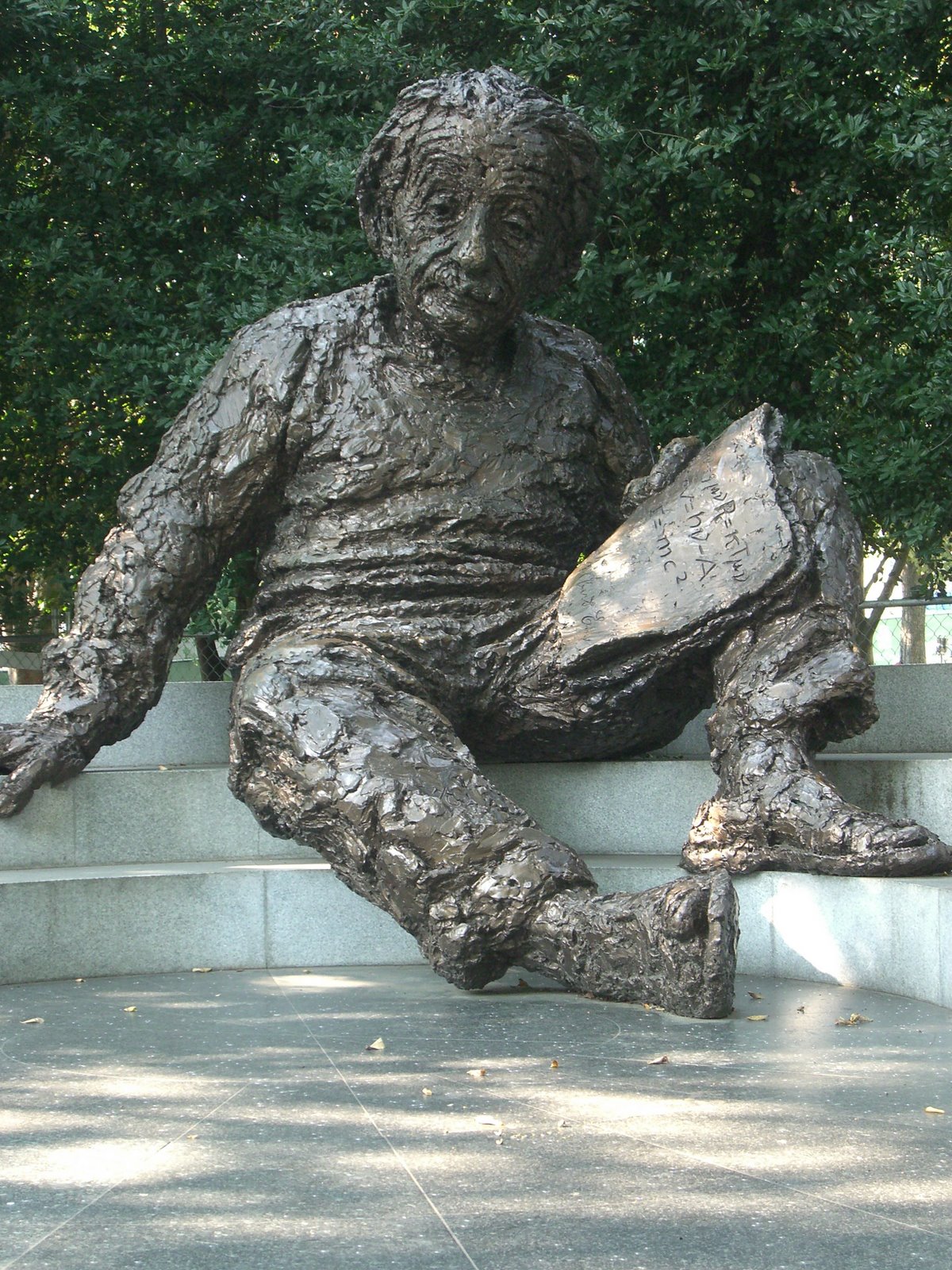
EINSTEIN'S INTUITION
It consists of four interviews with Einstein by Dr. Hermanns, who was initially Einstein's fellow Berliner and then his fellow exile. Hermanns is a sociologist and poet, who has strong mystical leanings and little understanding of physics. The first interview takes place in Berlin as the Nazis are gaining strength and becomes entwined with marching Brownshirts. It is both a wonderfully and terrifyingly bizarre piece, and it would make a striking movie or perhaps play.
The next three interviews take place in the United States during and after the war. Although lacking the drama of the first, they are equally informative. Hermanns continually goads Einstein to talk about things that he is not comfortable talking about, such as mysticism, and then pokes fun at his own obtuseness for continuing to press him. Nonetheless Einstein reveals a great deal to him. The interviews contain a treasure trove of information about Einstein's understanding of intuition. I thought I had the intuition bug, Einstein had it even worse!
Intuition can take many different forms. I identified deeply with a portion of what Einstein said about it. "Yes that's what it's like for me," I found myself saying with wonderment and even delight at the recognition. This kinship to some of what Einstein evoked no doubt comes from the fact that we share a personality type.
After I finished the book, I copied down some quotes I found particularly moving or informative. By putting them one after the other and pondering them a bit I came to see that they formed a coherent, profound, and provocative worldview.
Intuition for Einstein—be it about cosmic law or about predicting the outcome of the Second World War—is intimately connected with feeling. Many associate both feeling and intuition with the gut. But for Einstein, intuition is grounded primarily in the feeling of the heart—in its receptivity and its tendency to move out. It depends on a deep caring and receptivity that pushes him to go beyond what is currently known or thought or happening in order make contact with the cosmic order.
The following passage comes when Einstein and Herrmanns are talking about the Nazis and the flaw in the German national character that lead to Hitler's appeal.
Einstein nodded: he was a good listener. After a pause he said, "The cosmic man must be restored, the whole man who is made in the image and likeness of the arch-force, which you may call God. This man thinks with his heart and not with party dogma. As I've explained before, there is an order in the universe – a cosmic order – and humans have the possibility of understanding these laws."
Einstein leaned back in his chair; so did I,putting my writing pad on my knees. He added, "I have no doubt that the allies will win the war."
I smiled, "Oh, you are my prophet again."
"Prophet or not," he scratched his head, "what I say is more often felt through intuition than thought through intellect."
Hermanns is constantly pushing Einstein to acknowledge his inherent mysticism. He succeeds in getting Einstein to say something that probably few scientists today would say—that there is a vital force or energy in creation. Einstein is willing to associate energy with what are generally seen as spiritual concepts.
I pulled out some notes. "Once, in England, I was at dinner with people highly trained in meditation, among them Professor Suzuki who asked me to ask you if spiritual vibrations and electricity have the same original cause or force."
"I believe," Einstein answered, "that energy is the basic force in creation. My friend Bergson calls it élan vital, the Hindus call it prana."
This acknowledgment of at least certain types of energy that cannot, or not yet, be measured by instruments is noteworthy but it is perhaps not completely surprising. Einstein was responsible for showing us that matter and energy are interchangeable. He understood empiricism to be only a tool of intuition. Finally like Spinoza, he saw God, the universe, and all of life as a harmonious whole.
Einstein looked through the window and seemed to mumble more to the trees than to me, "I believe that I have cosmic religious feelings. I never could grasp how one could satisfy these feelings by praying to limited objects. The tree outside is life, a statue is dead. The whole of nature is life, and life, as I observe it, rejects a God resembling man. I like to experience the universe as one harmonious whole. Every cell has life."
He turned to me and smiled, "Matter, too, has life: it is energy solidified. Our bodies are like prisons, and I look forward to be free, but I don't speculate on what will happen to me. I live here , and my responsibility is in this world now..."
Experiencing the universe as a harmonious whole, there is no reason to fear either life or death. True religion depends only on holding the world in a receptive, caring, and judicious way—on conscience. This opens the door to intuition, which allows at least Einstein to glimpse the law conformability of the universe (and the rest of us too, although no doubt somewhat more dimly).
"The truly religious man has no fear of life and no fear of death—and certainly no blind faith: his faith must be in his conscience. Then he will have the intuition to observe and judge what happens around him. Then, he can acknowledge that everything unfolds true to strict natural law, sometimes with tremendous speed."
As a part of the cosmic order, certainly Einstein, and perhaps all of us, have a purpose which we can recognize with our intuition. Since our instructions or purpose comes from this harmonious whole, we are participating in eternity in the present.
"Indeed, it is not intellect, [which means book knowledge and empiricism for him], but intuition which advances humanity. Intuition tells man his real purpose in this life... I do not need any promise of eternity to be happy… my eternity is now. I have only one interest: to fill my purpose here where I am. This purpose is not given to me by my parents or my surroundings. It is induced by some unknown factors. These factors make me part of eternity. In this sense I am a mystic...”
As an inherent part of this totality, we are much larger than we usually experience. Einstein's religion, like Spinoza's, is that the universe is rational. The highest calling is to ponder its laws. Our usual ways of knowing are crude and cannot comprehend the coherence and beauty of the universe. Only the heart with its intuition can lead us beyond what we know of the universe and of ourselves.
Einstein leaned forward, "… it is not a religion that teaches that man is made in the image of God—that is anthropomorphic. Man has infinite dimensions and finds God in his conscience. This religion has no dogma other than teaching man that the universe is rational and that its highest destiny is to ponder it and co-create with its laws. There are only two limiting factors: first, that what seems impenetrable to us is as important as what is cut and dried; and: second that our faculties are dull and can only comprehend wisdom and
serene beauty in crude forms, but the heart of man through intuition leads
us to greater understanding of ourselves and the universe."
Although intuition is what allows us to move forward—is the most important part of thinking—it alone is not enough. Knowledge also has its place, but intuition is the gatekeeper at the most critical juncture. Even though the workings of intuition remain mysterious, it is a reality.
"Isn't truth inherent in man?" I interjected. "You once told me that progress is made only by intuition, and not by the accumulation of knowledge."
"It's not as simple as that," replied Einstein. "Knowledge is necessary, too. An intuitive child couldn't accomplish anything without some knowledge. There will come a point in everyone's life, however where only intuition can make the leap ahead, without ever knowing precisely how. One can never know why but one must accept intuition as a fact."
October 12, 2007
ON BEING JEWISH
1) Budapest: Summer 2007
It was my first day of sightseeing in Budapest. I had decided to leave the Jewish quarter until after the four day conference I was attending---the official purpose for my visit. I had been warned that the story of Hungarian Jewry just before, as well as during, the Holocaust was particularly dark. Hungary was an ally of Germany during the war, had passed its own exclusionary laws in the 20s, and until the very end took care of its "Jewish problem" on its own.
Much of the afternoon I walked around the inner city assiduously following a walking tour in my Frommer's guidebook to Budapest. Determined to pack as much into the day as I could, I crossed over the Danube to Buda and took the funicular up the hill to the castle district. In addition to its monumental buildings, the castle district consists of a number of streets with attractive small houses. The guidebook listed a number that were of note. One, at Tancsics Mihaly u. 26, had been a medieval Jewish prayer house. This is what Frommer's had to say.
This building dates from the 14th century. In the 15th and 16th century, the Jews of Buda thrived under Turkish rule. The 1686 Christian reconquest of Buda was soon followed by a massacre of Jews. Many survivors fled Buda; this tiny Sephardic Synagogue was turned into an apartment.
Then I saw unbidden in my mind's eye men in long dark frocks and yarmulkes, wearing intelligent, worldly expressions, coming out of the building, perhaps after prayers. They did not seem exotic or even strange to me. Instead I experienced a striking kinship in consciousness with them, perhaps more so than with any other figures I have read about and/or conjured in my mind from the past. I felt I knew them---could feel their inner current, sense their joys and concerns and how they held them together. I continued on my tour, without even thinking of taking a picture.
While I was recounting my adventures to myself at the end of the trip, I left this one out. In the back of my mind I knew there was one more, of a slightly different kind. Indeed the image was among the most vivid I've ever had ---at least of things I have not actually seen or experienced.
2) Poland, Museum at Auschwitz: Summer 1979.
Close to the end of the exhibition, the photos gave way to canvases showing Jewish life. A tableau of a bar mitzvah boy reading from the torah, flanked on one side by his father and on the other by the rabbi, conveyed both in the treatment of the figures and the light, a strong sense of the sustained upward impulse of Judaism towards spirit. In it I discovered the basic religious urge that is at the core of the Jewish experience. From childhood on, even as a reformed Jew, I had experienced it again and again, but mythically in the sense that I could not abstract its meaning from the experience. I realized that even as an agnostic, I had been strongly influenced by this very gentle reach of my community upward toward the sacred. Before it had been somewhat comforting to unknowingly partake of it from time to time; here at Auschwitz I understood what it was, saw how much it had shaped me, and realized its sustaining power.
Israel---Summer 1979
After visiting Auschwitz, I longed to be in Israel. However, once there I felt dispirited and disoriented. I blamed the heat in August and being alone after having been so well cared for in Poland. From my current vantage point I recognize that my distress resulted from my recent encounter with the destruction of European Jewry and the impossibility of satisfactory integrating these events.
As I was going through the motions of being a tourist, I met an English actor, about ten years older than me, on a camping tour of the Sinai Peninsula. An orphan, he had been brought up by the Jesuits. When I told him of my visit to Auschwitz, he shared the Jesuit perspective on anti-Semitism. Christianity was viewed by his teachers as an advance over Judaism because it offered the hope of resurrection. The resurrection of Christ held the promise of the induction of individual souls into a heavenly life at death. The rejection by Jews of Christ was then a rejection of the concept of individual afterlife. The basic impulse of Western anti-Semitism, my friend felt, arose from an unconscious mechanism by which Christians who lack faith in the possibility of life after death combat their inner doubts about life after death by attacking those who do not believe in the resurrection of Christ.
I was intrigued by the ability of this theory in one deft stroke to account for so much. It seemed to explain Hitler's obsession with a "final solution" and his sense of it as righteous work in a particularly powerful way. At one level I was convinced, but at others harbored some doubts. Even though I knew Reform Judaism does not mention life after death, I was poorly informed about other Jewish views. Moreover, the Messianic tradition clearly implies a resurrection of a sort.
Later I found out that the focus of the Jewish tradition is indeed generally on present life: on reaching to God through ritual observance, prayer and even complaint, on acts of loving kindness, and on social justice. However various Rabbis over the centuries have spoken of individual resurrection and afterlife. The mystical arm of Judaism emphasizes the fate of the soul after death. But they teach that originally a spark of divine light, the soul at death merges with its divine source.
I returned to Jerusalem and said good-by to my actor friend. A day or two later, my eyes happened to meet those of a pleasant, simply dressed young man. In part from the extraordinary depth of repose I experienced when our eyes met, I realized in an intuitive flash that this man was a Christian---and a true one. I understood the tranquility and penetrability of this apparently simple young man to reflect his close grounding here in the Holy Land---possibly even unsullied by scientific thought---to a religion that holds at its core the view that individual life can continue in some manner after death.
Whether this man in fact was a Christian is not important. He embodied for me in its purest form a different organizing filter than my own and my tradition to the question of living. I am still engaged, and suspect I will be for a long time, in the process of reclaiming from that unconscious place where intuitions come from and are again stored all the insight inherent in that moment when my eyes met those of this young man.
In the years since I returned from this trip, I have become more involved in Judaism and spiritual life. I yearn, I question and I wrestle, in the manner of many Jews, to know first hand that organizing filter or psychic signature of my religion at its best. I first saw it fully amid all the death at Auschwitz.
************************************
These passages were part of an early version of a chapter for an anthology on growing up Jewish in America, called Daughters of Kings. In the end I decided not to include the story about my actor friend and his theory about anti-Semitism in my chapter, called "The Other Side." In it I write about growing up in the shadow of the Holocaust, attending a Trinitarian boarding school, and the trip I took to Poland, Auschwitz, and Israel after handing in my dissertation.