Showing posts with label family matters. Show all posts

May 22, 2008

Salmon, Rice, and Peas--and Swiss Chard too


On weekend evenings when I was a child my family often had no-bother meals. One favorite was salmon, rice, and peas all mixed up together. The other was bagels and lox, which we had most Saturday nights. Bagels and lox are of course an ethnic tradition, but salmon, rice and peas seemed to be particular to my family.

The salmon and the peas were canned and the rice was Minute Rice. I can't say I loved the dish then, not like bagels and lox. But it was comfort food.

Over the years, every month or so I have had a yen for salmon rice and peas. I still use canned salmon but I’ve upgraded to frozen peas and longer cooking rice. At first I missed the special sweet, processed taste as well as squishy texture of the canned peas. But it's actually better with frozen peas.

Other than the above changes, I have been pretty faithful to the original recipe. This is not to say it always taste the same. To the contrary it’s not just one dish but a whole family of dishes---at least to my salmon-rice-and-peas-attuned palate. By adjusting the proportion, the salmon can dominate, the peas can dominate, or anything in between. Each of these endless variations can have tends to have subtly different overtones and undertones.

I just throw it together with minimum thought. However I cannot exclude the possibility that my unconscious mind is tailoring the mix to the needs of my palate (or my psyche) for the evening. Intuition can direct our actions whether or not we listen for that inner voice. Of course the best cooking comes about when we listen (see
Intuition and Brussels Sprouts---what!?).

After a long abstinence, a few weeks ago it was a salmon rice and peas night. I had an idea for an alteration I just couldn't get out of my mind. My latest culinary enthusiasm is chard. I had a few leaves of chard in the refrigerator (with only one or two good days to go). Breaking all my year of salmon, rice, and peas near-purism, I considered cooking them up and throwing them in.

This was not something to be undertaken lightly. It seemed a sacrilege as well as a boundary crossing sure to have consequences other than the simple success or failure of the dish. Moreover why was I thinking of changing a trio that already played endlessly interestingly together into a quartet? Eventually I recognize that in spite of my careful conscious weighting of the pros and cons, the project was going forward. I started cooking the chard.

I usually do not add the juice from the salmon to the concoction. But chard has a strong taste. To balance it I decided I needed to add the juice as well as the whole can of salmon.

The first bite left me astounded. It was delicious; the flavors were bright and exceptionally well-balanced. But even more than that, it evoked my mother's palate—everything that was good about her cooking—perhaps more than anything I have tasted since her death.

I certainly crossed a boundary. But instead of moving further away from tradition it brought me closer to its core. Looking back, I guess I was never so crazy about salmon rice and peas, because it didn't have the brightness of my mother's weekday food (especially with those can canned peas).

-----------

My mother wasn't a particularly skilled cook, but her food was tasty and she relished eating. She ate slowly and luxuriated in it perhaps more than anyone else I have ever known. All this was permission-giving to me. Learning to cook from Julia Child's Mastering the Art of French Cooking was a prelude to my scientific career.
(see Food and the Spirit: Rededicating My Thesis 27 Years Later)

My mother also became interested in the kind of cooking championed by Julia. She however had a severe handicap. She just could not grasp what it meant to sauté something. She was fascinated by the concept and often asked me to explain it to her. She would seem to get it, but a number of months later she would ask me again. She was an intelligent woman, and I was incredulous at her apparent idiocy about the concept of sautéing.

After my experience re-creating the essence of my mother's food, I decided to look up sauté in the dictionary. It says:


To lightly fry in fat in a shallow, open pan—n. [French, "tossed (in a pan)," from the past participle of sauter, to leap, from Old French, from Latin saltara, frequentative of salare (past participle), to leap....]


Food leaping from the pan is a lovely image for sautéing. But I began to see that it is also somewhat problematic of a concept. Leaping is a relative thing—or rather the time of cooking before leaping. I'm not sure we really want sautéed chicken breasts to leap from the pan until the chicken is cooked. We don't want sautéed mushrooms to leap from the pan until they give back their juices.

These legalities—although I can't say exactly how—helped give me some insight into my mother's problem with the concept of sautéing. She sautéed all the time. She just couldn't figure out how it was different from pan frying or browning. She already had categories and she couldn't fit a new one in, especially one that is, like the others, not so well defined.

At some level I suspect her question was less about sautéing than it was about the essence of French cooking. This new technique she thought she could learn—if she could figure out what it meant— just might help situate her in this celebrated cuisine. And indeed Julia does mention a large number of tips in Mastering Vol I, such as high temperature and drying food with a paper towel (Ug, See
Intuition and Brussels Sprouts---what!!?). But it wasn’t really a new technique, rather just another name for what my mother on occasion already did.

In contrast I first learned to cook in the context of French cooking. I didn’t pan fry food but did that thing called sauté from the start. Also thanks to Julia, I had much of the context that went with it. I would not be surprised if other women of my mother's age felt the same way about sautéing, but were ashamed to admit it and kept their perplexity to themselves.


----------

My mother's difficulty was that a new word was used for a deeply familiar technique. Something similar can occur when familiar words are used in a new context. This happened to me around my first computer, a Mac. I was profoundly intimidated by frequent reference to “a finder” and to “a chooser.” I felt the same way when somewhat later a computer-savvy colleague said of a computer, “This machine has no security. I have to put some on.” I was dumbfounded. It was clearly important, but security meant men in uniforms. How could you put men in uniforms on a computer?

These words were chosen because they were considered intuitive in the sense of user-friendly. But I didn't know enough about computers (or computers with high-level languages) initially and then the internet to have a context for them. Because they were familiar words used in mysterious contexts, they seemed doubly impenetrable to me--- uncrossable barriers between those who were in the know and those who were not.

Our categories—the way we break the world up into kinds—are essential to our ability to construct meaning and hold onto it. After awhile it becomes hard to rename them, give them new context, or add another ingredient. To be sure “it is hard to teach an old dog new tricks.” But perhaps there is a more subtle lesson to be gleaned as well.

The categories that help one person or group make sense of the world can be different or have different contexts from those of another person or group. Sometimes it takes an act of intuition—along with some compassion for the way we all tend to hold on to familiar meanings—to translate in between. Good things tend to happen when we make the leap!

-------------
Coincidentally, it turns out that the word Salmon is from the same root as sauté. The Latin name for Salmon is Salmo, hence the jumping or leaping fish!


I'd love to hear about your favorite comfort food---with or without embellishment.

December 23, 2007

The Way the Mind Works: Screens, Walls, and My Uncle Manny

Credit: Joseph A Carr-From Wikipedia article on Telephone Swithboards


I was speaking with my (almost) 97-year-old Uncle Manny recently, who lives in Florida. As we often do, we were talking about the old days when he and my father, who died a number of years ago, were boys. We were marveling at how easy it had become to stay in touch since then. The telegraph replaced letters as the only way to reach across distances, and then came the phone.

He told me that his grandfather had one of the first phones in the neighborhood. It was a pay phone of sorts. Neighbors could come and deposit their nickels to make a phone call. The phone company charged a set fee and also got a percentage of the take; my great grandfather got to keep the rest.

We discussed how phone technology had changed---from operators, like Lily Thomlin's "Ernestine," who connected calls on a switchboard, to rotary dial phones. He reminded me of how for a number years if you wanted to make a call overseas, you had to tell an operator, she would place it for you, and then call you back when she had the other party on the line.


We continued with touchtone phones, then cell phones and e-mails. (Great site on history of the telephone ) Keeping on with technological progress and communication, I told him about the voice activated wordprocessor I use because a repetitive strain injury limits my ability to type. It's called Dragon NaturallySpeaking. You can begin using Dragon right away to type text, but it takes awhile to learn to some of the more subtle maneuvers connected with word processing, such as formatting and moving files around. (See Voters Beware: A True Fable to learn about some of its more disarming idiosyncrasies.) It's taken a year or so, but I've now become quite good with it and can do most of what I want to.


One of the ways Dragon lets you move the pointer around on the screen is by saying commands like "start scrolling down," "move mouse right," "move mouse left." When you want the pointer/mouse to stop you simply say "stop." It can be a little tricky to get it to stop just where you want it to, because the voice recognition adds a delay. So you need to say stop just a little before hand.

I had an unusual experience the other day that suggests that technological innovation can go two ways. It seems as if my friend Dragon NaturallySpeaking is beginning to rewire my brain. I had been working very hard that day and late in the afternoon I slipped out to go to my local Whole Foods to go grocery shopping. I was going up and down the aisles, perhaps thinking about my work, while grabbing what I needed. I was in the frozen food aisle when apparently some part of my mind feared that another shopper going the other way down the aisle would soon be in danger of colliding her cart with mine. All of a sudden I found myself saying “stop,” but not to her, or even to her cart. Instead I was talking to an invisible screen, and rather quietly in my flat Dragon voice, which I doubt she even heard. Nonetheless she stopped at the entrance to the little cheese alley and no collision occurred.

I came to full alertness when I recognized what had happened and furthermore that she wasn't even really that close. I felt equal measures of amusement at what had happened and concern for my poor addled brain.

My uncle and I had a good laugh about my mistaking real-life for virtual reality. Then he said, "That reminds me of a story. I'm not sure exactly why it's coming to mind, but somehow it seems to fit."

"Former President Eisenhower went to visit Israel and was shown around by Golda Meyer. They went to the Wailing Wall, where he saw religious Jews in prayer shawls dovening, or moving back and forth as they prayed. He also saw people slipping scraps of paper into the cracks between the stones. Intrigued he asked Golda what was going on. She explained that they were leaving prayers on these scraps of paper.

Eisenhower said he would also like to leave one. He wrote something on a piece of paper and placed in the wall.

Golda tried to contain her curiosity, but eventually it got the best of her. She said, "Mr. President, excuse me for asking, but I am most curious about what you prayed for."

Eisenhower answered, "I asked for peace between the Israelis and the Palestinians."

"Ah, Mr. President," Golda answered, "you know of course you are praying to a wall."


Additional thoughts: I don't for a minute believe that my "intervention" was the critical factor in averting a collision. But at the same time, I trust these unconscious responses, especially as they relate to traffic. See Running in Herds, Traffic, and Intuition. Not only do we read momentum, like other animals, we also read intention, and from many different cues. We somehow know, for the most part, if someone we are observing is planning to keep on going, or if they are thinking about making a turn. Nonetheless I would put my money on the fact that the woman just remembered at that moment she needed some cheese. At the same time some trouble-making part of my mind just won't let go of the possibility that something about “my response” to this situation---since she was looking right at me---triggered her stop.

While speaking to Manny again a few days ago, I learned that the Eisenhower/Golda Meier story I had heard for the first time from him was in fact very well-known a number of years back. Intriguingly, even though the story has faded, the situation it captured is unchanged. Everything moves on—technology gallops along, good stories are forgotten. Yet(as Golda intuited) the Israeli Palestinian situation remains essentially frozen in time.

I am going to proffer my own solution to the Israeli-Palestinian situation. How about if everyone on both sides started using Dragon NaturallySpeaking to help prevent repetitive strain injury. After all real-life reality, virtual reality, and metaphoric reality are all likely equidistant from each other.


June 05, 2007

FOOD AND THE SPIRIT (or Re-Dedicating my Dissertation Twenty Seven Years Later)


I have a rare chance to make up for a lost opportunity. I had wanted to dedicate my PhD thesis to Julia Child. The topic had nothing to do with cooking, at least in the way the word cooking is generally used. I was studying how digestive enzymes, which are large proteins that break down the food we eat, get from the pancreas where they are made into the gut.


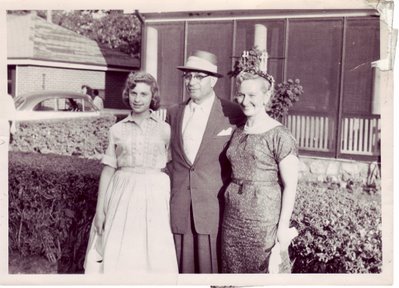
Instead when push came to shove I decided to dedicate it to my younger brother. He had died my junior year in college of cystic fibrosis, just shy of the age of thirteen. Cystic fibrosis is a disease in which digestive enzyme secretion is impaired and children cannot breakdown the food they eat. That's him below at my older brother's wedding---capturing the action. Had Bruce lived, he---not I---would have been the scientist in the family. Not least because my dissertation happened to be on digestive enzyme secretion, it seemed right to dedicate it to Bruce. I am glad I did.


I was drawn to the idea of dedicating my dissertation to Julia because learning to cook from her exceptional cookbook gave me the courage I needed to go into science. An intuitive type, I had always been a bit spacey. I had assiduously avoided serious science, and especially laboratory science, feeling it alien to the likes of me. Learning to cook in the years just after college under Julia’s tutelage gave me confidence in my ability to weigh and measure. She did much more; she helped ground me in the world of sensation and also introduced me to the pursuit of excellence.


Though nominally I was teaching, my real job---and joy---was cooking. In the beginning my love affair with Julia and fine food took place in a tiny closet of a kitchen with no counter space what-so-ever and only a 2 x 2.5 foot table. Nonetheless I followed almost every step of her recipes as if they were sacred texts that held the secret to life. In some sense to me that's just what they were--- and I suspect I was not the only one. Julia opened this country up to the joys of the palate and much more.


I wonder did Julia serve as a stepping stone into science for anyone else---or am I the only one? As a youngster I knew science was supposed to be about observing the natural world, but little I saw jibed with what scientists supposedly said--- like apples and feathers falling at the same rate. At another level the control and precision that experiments required was not associated with women for me. Women didn't control the environment, men did. I don't think a male Julia Child, clarity, nonchalance, breathiness and all, would have had the same influence on me. Because Julia was a woman, she gave me permission; once I had begun to master French Cooking, the possibility of mastering other things became real to me as well.


My skill with cooking eventually went beyond just following Julia’s instructions. As I mentioned in my last post "Intuition and Brussels Sprouts," sometimes when I put myself in a special non–thinking but completely attentive state while adjusting the seasoning of the dish, I would know just when it was enough. Cooking tends to involve great deal of implicit learning, unconscious information processing, and expertise. However the connection between cooking and intuition is even deeper.


Years ago, when a friend and I were traveling together throughout Western US and Canada, she taught me to choose restaurants by their signs. It turned out to be a pretty good rule of thumb--- a restaurant with an appealing sign generally had correspondingly good food. Over the years, I have thought a lot about what this special something is that goes beyond good design.

Sometimes even a very simple restaurant sign or simple cooking rises to the level of art. Like all art, it depends on a combination of knowledge, skill, and creativity that ‘cook’ together below awareness---in short on intuition. Yet I feel that artistic quality is neither necessary nor sufficient to explain a sign that draws you into a restaurant or the good food that so often goes with it. Sometimes a sign that bespeaks good food to me can by no stretch of the imagination be called art.


I suspect some even more basic intuitive alchemy connects the sign an owner of a restaurant chooses to hang to invite people in and the food they prepare. Both share an inherent movement or dynamism that appeals and sometimes even fascinates. We feel enriched by looking at them or tasting them—and perhaps especially when the dynamism is ‘oh so subtle.’ (It might come from a just barely perceptible rhythm to the lettering or composition.) The sign forms an appealing as well as self-sustaining, or continuing, pattern in space--- and the food an appealing and self-sustaining pattern of tastes. These patterns resonate with something etched in the human spirit. To the extent we linger with them, they connect us more deeply to ourselves and also at the same time connect us to something larger than ourselves.


On Julia's website at the Smithsonian below a picture of her in the kitchen in France where she first started to cook is a quote from her “The whole thing was an opening up of the soul and spirit for me." Food is the most direct way we take in the external world and make it part of ourselves. Much of the time we eat without awareness. We are just following our biological imperative to survive. But when we do it with consciousness, this transmutation of world into self can also become a bridge between the sensual and spiritual. To begin with, as the tradition of saying grace highlights, we appreciate the bounty of the earth.


When the food is really delicious---to the extent we savor it--- we are also led into different and more rarefied realms of appreciation and even joy. The cook who pats herself on the back for making a wonderful new dish, in addition to appreciating her own skills, is celebrating---even when she doesn't know it---the slightly enlarged world of nuanced experience her own intuition has opened for herself and guests. (Of course, this opening might instead depend on the intuition of others codified in a recipe, combined with her skill.) When she makes and serves an old favorite, she revisits that special place again.


If you want to get heightened sense of the way food can carry one beyond oneself to new places, you might try a radical experiment---eating a wonderful meal in the company of friends in complete silence. It is hardly anti-social! Rather to the extent one remains present, it leads to an intensified experience of both food and friends. “It is the nectar.” as a friend who I convinced to lunch in silence on the veranda of a lovely restaurant in Italy during a busy conference said. Alas, Julia opened the possibility of experiencing this nectar for so many of us.


Had I dedicated my thesis to Julia back then, my appreciation of her influence on my life would have been incomplete. I was still years away from my current interest in exploring and resonating the experience and science of intuition. But what is a mere twenty seven years when completeness is at stake? Here is the original dedication, and below what I would now add:


This dissertation is dedicated to Bruce Isenman. He wanted to be a scientist, and I believe nothing would have stopped him had he lived.

This study is also dedicated to Julia Child. By teaching me to weigh and measure with the best of them, she gave me the confidence I needed to become a scientist. I now know that she also helped chart my course beyond to resonate more subtle yet no less real realms of knowledge and experience with scientific understanding.


************************************
************************************


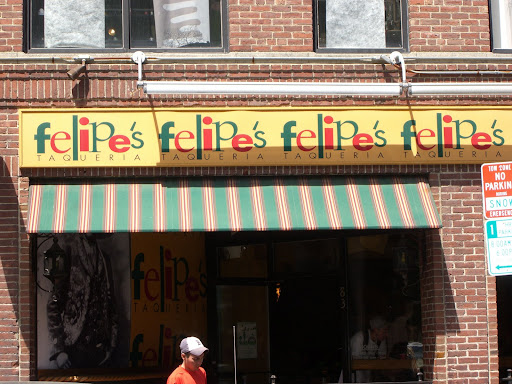
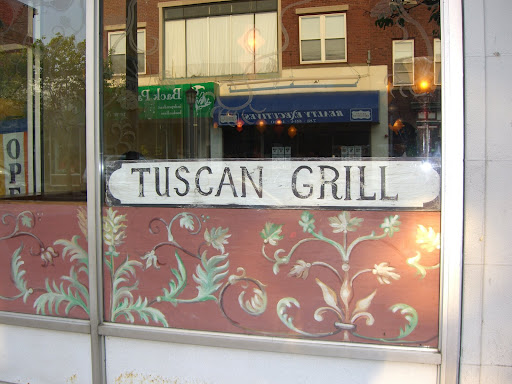
OTHER RESTAURANT SIGNS I THINK INTERESTING
(A Work In Progress)

I have not eaten at all these restaurants whose signs I think bespeak good food or find interesting for one reason or another. It is no doubt a better test of the rule when the food is unknown. (I apologize for the quality of some of the pictures. I am using Picasa for the first time, and the quality of the uploads seem inconsistent. Any insight appreciated.)


I am not sure about what these signs reveal, but I am certainly intrigued by them. The restaurant has been there since my college years and back then had excellent subs. It recently closed.


This one has changed hands at least once and probably more---so it might be a legacy issue as well.

The signs in the foodcourt of the Porter Exchange in the old Sears Building in Cambridge seem to be all by the same artist. They are very attractive but to my mind verging on slick. I think signs by an artist hired by a corporation for a foodcourt are less telling. Most of the food is quite good at the Porter Exchange, if I remember correctly, and hardly slick!


January 06, 2007

Breaking Ground---A Little Lower Than the Angels

Being the first, I am coming to realize, is not always all it is cracked up to be. I was the first to come up with the metaphor a blink of the eye for unconscious cognition and intuition and published it in 1997---long before Malcolm Gladwell and Blink. I am proud of it, but it has been a mixed blessing. Another first is that I was the first girl to have a Bat Mitzvah at Temple Israel in Boston. It was also a mixed blessing, but in a different way. This post is about my Bat Mitzvah. If you want to know more about my experience around the blink of the eye metaphor for intuiton, check out my Oct 24 post, Things Are Not As They Seem.

Sometimes I say that my mother was the first Bat Mitzvah at Temple Israel, because it was her idea. She was a feminist before her time. The first girl after four boys, like her brothers, my mother became a lawyer. Yet she practiced only briefly; parts of her nature were not really suited to it. She struggled instead, as she put it, “to accept her role as a wife and mother."

I had very little to do with my Bat Mitzvah except to learn my Torah part. I don't remember learning it, I don't remember when the idea of me having a Bat Mitzvah first came up, and I don't remember how I responded to the idea. Obviously I didn't object seriously. But I wonder, did I say “Yes,” enthusiastically, or did I say, “It's okay with me, if you want me to.” Most of my experience around my Bat Mitzvah is shrouded with this kind of vagueness and haze.

My older brother’s Bar Mitzvah I remember well. I remember Paul studying his Bar Mitzvah part, I remember the monumental preparations---especially the wonderful engraved invitations---that consumed my mother. I remember the luncheon and the magician who did the entertaining. I also remember how happy I felt. It seemed a mitzvah, a blessing, for the whole family.


I also remember the extraordinary charm bracelet wonderful friends of my parents gave me. I still have it. It has a book that opens, a watering can with a bird on it, a bell, and a lock with my name engraved on it---and other charms as well. It was right up there in my mind with engraved invitations.

Even my misanthropic grandfather, my mother's father, who didn't attend family celebrations came to my brother’s bar mitzvah. That was quite a coup--- though he wouldn’t let anyone know he was coming for sure until the last minute. What I don't remember directly, I can pretty much reconstruct from the abundant pictures and movies taken of the event. As I write this, I feel choked up; Paul's Bar Mitzvah had that much meaning to me.

I suppose at some level I did not object to the idea of having a Bat Mitzvah because I too wanted to be the center of so much meaning. Yet the only things I remember when it first came up was the wonderful anticipation of the engraved invitation that would announce the event. Engraved invitations were so reified, so official, so beautiful to me. I was certain that they transform the messiness and changeability of self into a sleek and compelling, permanent public offering.

But back to the haze. Yes I wanted to be the center of so much meaning, and I certainly wanted whatever my brother had, but I did not feel it was really kosher. After all I was only a girl. My brother---the first child and a son--- deserved all this fuss because at the age of 13 he became a man in the eyes of the congregation , and like generations of men before him could be part of a minyon or called to read from the Torah. I had no model for Jewish women having an equal role in official religious practice. Without this how could I feel I deserved this ceremony of coming of age or find emotional or spiritual meaning in the experience. Without this it was---at least at the conscious level, a short-term celebrity grab--- although one eminently justifiable from an egalitarian point of view.

Apparently my mother, the prime mover behind my bat mitzvah, felt the same ambivalence. I know because SHE DIDN’T ORDER ENGRAVED INVITATIONS, she wrote them out by hand instead. She tried to tell me that it was much nicer, more personal--- but she didn't fool me.

No doubt another reason for my haze surrounding my Bat Mitzvah was it was also my first year at boarding school. Since my birthday is in October, so I had been at Howard's Seminary for Girls, about an hour away from our home, for only a month or two before the ceremony. Anticipating going away from home, must have taken up a lot of my emotional energy in the months before.

My Bat Mitzvah might have happened on Oct 13. (I am surprised that any date came to mind.) I came home for the weekend. I remember what I wore; it was my good outfit---a purple wool skirt with a matching purple sweater. It seemed sacrilegious not to be wearing a new outfit to one's Bat Mitzvah.

I don’t remember anything about the service. The party was in the reception hall at the temple. The only thing I recall are spotlights held by someone standing on a chair taking pictures, which bothered my eyes. I do not remember ever seeing any pictures, either stills or movies. I do not remember getting any gifts. Perhaps my mother had also written on the invitations-- no gifts.

For years I have felt secretly ashamed of what a non-event my Bat Mitzvah was for me. Only in thinking about writing this piece have I realized that the vagueness I felt was completely appropriate. Extending the coming of age ceremony to girls in 1956 reflected the same urges that eventually gave birth to the feminist movement 10 or so years later. No doubt my own deep-seated but inarticulate feminist and egalitarian feeling were a factor in me going along with my mother's more articulated feminist desire for me to have a Bat Mitzvah. But like my leaving home to go to boarding school, this leaving what was known and making the transition to something other was deeply conflictual. In the world that has made me, girls were lesser than men and did not have Bat Mitzvahs, and did not read from Torah, but in the world that made me also girls did not want to be the lesser than men. No wonder I felt vague.

There was one tangible and very important result of my Bat Mitzvah. Like Bat Mitzvah boys, I had to promise the temple that I would continue with religious school until confirmation in the 10th grade. For two years at Northfield School for Girls---where I went for high school---I attended religious school by mail. The second year the text was a book written by the head rabbi at the Temple Roland Gittelson, called Little Lower Than the Angels. It was about the place we humans have in the cosmos, a topic that resonated deeply with me and continues to do so today.


Saturday evening, when most of the girls would go to movies in the auditorium, those of us who stayed behind would gather in the living room, listen to classical music, and quietly do our own thing. I would read Little Lower Than the Angels and answer the questions in the worksheets sent to me monthly. The sense of peace and contentment was so complete that I experienced the others returning from the movies as an unwelcome and fatal intrusion; it broke the circle of Being until the next Saturday night. Along with my brothers Bar Mitzvah and reading the funnies on Sunday morning on the living room floor, while my dad read the Globe in his chair, these Saturday nights at Northfield stand out in my mind as the richest and most contented epxeriences of my young life.

Years later I indirectly wrote about my brother’s Bar Mitzvah for a book about growing up Jewish in America called, Daughters of Kings. I described the trip I took to Poland and to Auschwitz. Talking about my experience at the Museum at Auschwitz, after visiting the death camp,

Close to the end of the exhibition the photos gave way to canvases depicting contemporary Jewish life. I scanned quickly until my eyes came to rest on tableau of a bar mitzvah boy reading from the Torah, flanked on one side by his father and on the other by the rabbi. …I felt completely absorbed. In its treatment of the figure and the light the picture revealed to me a sense of the sustained upward impulse of Judaism into spirit. In it I recognize the basic religious urge that as the top the core of Jewish experience. The gentle streams of light filling the sanctuary above the figure evoked feelings of both profound yearning and fulfillment. The loving life gave both new and renewed meaning to the familiar images of Torah reading and religious coming of age; in that moment I realized how thoroughly Jewish I am.

I am still not an observant Jew, yet spirituality is an anchor of my life, and being Jewish another. Just perhaps had I grown up in an egalitarian tradition, I would have found a place for myself within traditional Jewish practice. At the unconscious level I am almost sure that having a bat mitzvah did hold spiritual meaning for me. In any case I take great comfort in the fact that being one of the pioneers of Bat Mitzvah has helped make room for Jewish girls to receive the holiness signified in the Jewish ceremony of coming to age, I felt so clearly that day at Auschwitz.

I suspect that successful traditions generally begin in vagueness. They are for the most part the result of an intending that comes from someplace much deeper and impersonal than the conscious mind. They are precognitive and their implicit goal is to change the context within which we experience. The conscious mind goes along, perhaps making up convincing sounding reasons that turn out to be correct, or perhaps just not knowing why. Yet with time, as these traditions influence the world they create a context of meaning that makes them fit at all levels of experience--- emotional, intellectual, spiritual, and historical.
_______________________

After I posted this, I became haunted by the following passage Rosie Rosenzweig had written about her mother at her daughter's Bat Mitvzah. Born in 1900, her mother grew up in Grodno Poland; she immigrated before WWII to Canada to join Rosie's father, who had left several years earlier. The passage is from a longer piece called "Mourning Becames a Bat Mitzvah." The piece is one of Rosie's contributions to Sweeping Up the Heart: The Wisdom of Our Grieving, an anthology about loss and grieving a number of us from at the Brandeis Women's Studies Research Center are putting together.

Her First Touch at 82
by Rosie Rosenzweig

True to the old world Jewish Mother stereotype portrayed in Fiddler on the Roof, my mother was in perpetual dialogue with God addressing him as Rebeyne Shel Olam (Teacher of the Universe) with an occasional Oiy Got (Oh God!) I remember at my own daughter’s bat mitzvah when my mother was honored with an aliyah (“a going up”) to the Torah; when the parchment scroll holding the first five books of the Hebrew Bible was unrolled, she became transfixed in awe. In Grodno this would have been a forbidden act – for a woman to plant a kiss on the fringes of a prayer shawl, and to then take those fringes and touch the opened scroll itself.

At 82 and partially blind, this experience seemed to render her in a state of momentary ecstasy.


I wrote a small sentimental poem, which was read years later when a newly written Torah scroll was inaugurated into the curtained ark after being carried under a bridal canopy. (At an earlier date, I was first given the same honor; I actually looked up at the ceiling to see if some flash would strike me down. Patriarchal Jewish chauvinism and years of being sent back from the men’s side of the synagogue in my youth had taken its toll.)

Can I touch it? She asked,
In blind devotion,
Groping the air above the scroll.
Can I really touch it?

And before the rabbi turned his head,
She lightly tapped her mouth
And then the parchment pure.

Can I do it once again?
And she knew it more this time.
I heard a learning from her mouth to me.
No lightning struck,
Nor clouds did part.

Only for a moment,
This memory opened up my sky.
My mother, my teacher,
May this blessing
Be more than a memory.


The easiest way to leave a comment is to click on “other” or “anonymous” and then begin writing. If you write a comment and then go to register with Google, it will be lost.
listening less anger

November 22, 2006

The Furnace and the Stove: Another Fable (with a strong personal note)

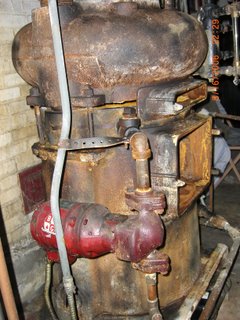
My older brother came to visit for a few days the weekend after I changed the old converted coal furnace for a spanking new boiler (Reason vs. Intuition). After about 20 minutes, I commented jokingly on my restraint at not yet having asked him to come see the new furnace. Immediately he marched downstairs to the cellar--- with me following. “It certainly is different,” he remarked, as he checked out clean-lined red heatsource that replaced the indomitable old snowman that had held court in the nether region of this our family home for eighty years.

Later over dinner he noticed that I had also replaced the old stove in the kitchen. (It was 5 years ago, when the third of four burners on the 60’s era electric stove became unusable. The new furnace apparently primed him to see the handsome, not quite new stove.) Half joking, and buoyed by good wine, I opined that replacing the stove was like getting rid of mother and the furnace, dad. We the children were finally in charge, I thought. It's way past time and all for the good.

Sometimes in spiritual circles it is said that you choose your parents. Besides the biological absurdity of this, it never made sense to me because I was clear that I never would have chosen the parents I got. They were good people; intelligent, funny, with excellent values---but nonetheless challenging parents.

My father was a patriarch with a scientific bent, who did not easily allow emotion or other people's needs.


“Dad, I have a question.”
“The answer is no, now what is your question?”

My mother was emotional and, as might be expected, increasingly needy over time. The strongly receptive part of her nature was constantly at war with the equally strong independent side. A truth teller, she was very often right. Yet even when she was right, in context she was frequently wrong. The house was too often a complex battle scene between my mother and father, or my mother and my mother, or my mother and everyone else.

A few days after my brother's visit, my aunt and I--- based on a plan we made months before--- went to the cemetery where my parents as well as her mother are buried. I had been to the family gravesite two or three times before and had found it a vaguely peaceful experience. The man in a yarmulke and jacket at the tasteful but frigid administration center pulled out a magnifying glass to find the site on his mimeographed plan of the cemetery. “Oh boy,” I thought, “this is going to be tough to find.” My concern grew when he realized that the first mark he had made on the map was incorrect and had to go through the procedure again.

Carefully following all the roadside indicators, we went round and round in circles between the carefully landscaped Mount of Olives and Mount Tabor. (I suspect a map of the Holy Land would have been more helpful than the mimeographed plan I had in hand.) “Perhaps they had recycled old the plot and sold it to someone else,” crossed my mind. After about 45 minutes---with the help of some reluctant maintenance men, we found the spot. I bristle at this kind of poor administrating, and I had to work actively to calm myself.

When I finally sat down on the small bench, my parents’ presences immediately filled my mind. I felt transported into a place of wordless communication and connection with them both. Most remarkable of all to me was how well my being fit with theirs. I never remember having ever experienced such clear consciousness and deep emotional connection before. We were separate --- it was a precondition for this delightful exchange--- but we were at the same time inexorably joined. This joining was harmonious, yet complex and dynamic--- like a wonderful rich trio sonata. It was an experience of complete spiritual communion . I don't know whether we choose our parents, but if we do, I now understand why I would have chosen mine. I also understand the rightness of their choice of each other.


I also don't know if the presences I felt were actual presences from the beyond, or my internalized sense of my parents. Because it's a simpler hypothesis and because I have no experiential evidence to the contrary, if pressed, I would definitely say the latter. But the answer to this question doesn't matter to me at all. Even if they were internalized presences--- it was a real encounter with internalized presences. This in the end might be more even more important. Replacing these weighty relics of my mother and father's material existence ---the furnace and the stove--- --- rather than excising parents, seems to have freed me to experience their spirits more deeply.

Like their material doppelgangers, they each gave a different kind of fire. My father's fire, the fire of the furnace, warmed and sustain life. It forged truth of the practical and worldly kind. My mother's fire, the fire of the stove, was of the psyche---it transformed the world so it could be absorbed. Its truth was the truth of essences---seeing through the surface of things to their intangible core.


I certainly would change many things, if I could do it again with executive control. But I see that---besides being formed by the very rich consciousness of these two beings --- I have inherited from each a priceless gift. From my father, I have inherited my analytic, scientific mind that strives for clarity. From my mother, I have inherited unusual receptivity and an interest in the powerful yet subtle reality of what we cannot see. Their vital fires are both part of me.

About 10 years ago, after a number of working as years as a scientist, I began studying intuition. There is lots of dissonance where I now sit right in the middle of the bridge between the furnace and the stove---the science and the experience of intuition. On one side is cutting edge science of the mind and on the other, subtle experience---including spiritual experience. My work has inherited the complaints of each side of the divide for the other side. A number of the scientists find it too experiential or anecdotal, and a number of the experience people are resistant to the analytic material.

I believe these often warring sources of transforming heat, the furnace and the stove, must learn to speak each other's language and to understand each other's truths. I am glad to be one of the crucibles in which this alchemical marriage is now occurring. The wonderful heat of this joining is such that, even with all the dissonance, there is no place else I would rather be.

November 12, 2006

Reason vs. Intuition


A number of books of an academic or semi-academic nature have appeared in the last number of years on intuition. Many of them highlight the conflict between reason and intuition. However, I think for the most part this is a false dichotomy, one of the many reasons I do not like these books. Also they only tilt their hats to intuition, while their deeper subtext seems to be that intuition is not to be trusted.

Intuition and reason most often work together. In fact, evolution demands that this is so. If they didn't, we never would have been successful as a species. For the most part, the confluence of reason and intuition occurs below the level of awareness, so we are not aware it is happening. Instead we only become aware of the relatively infrequent situations in which the two conflict. Very recently I did encounter one of those situations.

There was a small chance that the furnace could be fixed. My intuition told me not to replace it, but my reason said yes. The old one was a converted coal furnace, the original in the house---which was built in 1926. They were called “snowmen,” because that's what they looked like all covered with asbestos. It's time, I thought. I don't want it to fail in the middle of winter, especially if I am away on a trip.


It was not easy to say goodbye to all the funky bells and whistles of my old snowman. In fact, I saved the wonderful old pressure gauge to put on top of my shiny new heat box as a masthead of sorts. I now have a new spiffy red furnace, half the size of the old one. But guess what ---it turns out that the pipes bang when the heat comes on, which did not happen with the old one.
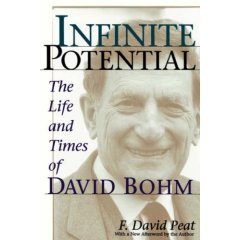
I thought I would call the company that installed the furnace and ask them to try to fix the banging. But my intuition said no! I didn't know why, but it seemed a serious warning ---so I didn't call.

The banging has woken me up several nights running. It also regularly jams the voice activated word processor I use. This is silly I thought, why suffer like this? So yesterday I again decided to call the company. Again my intuition said no. But this time I called anyway. They said they would come today; here I sit waiting for the repair man.

What is going on? First of all, a matter of definition: I am calling this an intuition because it came through the same channel my intuition generally does and with enough force for for me to listen to its guidance. This is not a rigorous treatment of this complex and thorny issue, but it will do to begin with.

One possibility is that this dire warning about the furnace was based on some precognitive knowledge. Perhaps the furnace is a lemon, the company is not trustworthy, or the repair man will come and make things worse. I certainly cannot exclude any of these possibilities.

However there is another possibility that is at least as interesting and as instructive with respect to understanding intuition. I live in the house I grew up in (I have lived many other places as well). The deep steady purr of the furnace played base to my father's rhythmic snoring. Together they were the nightsong of the house. At an emotional level in some sense removing the old furnace means removing my father and his influence---for better and for worse---from the house. Thus what seems to be a conflict between reason and intuition instead may well reflect an emotional conflict between my loyalty to the past and moving on. I'm not sure this is the reason my “intuition” is kicking up a fuss--- but I do know I have a lot of emotion going on this highly symbolic act of replacing the furnace/father.

Emotion and what we call intuition are highly linked. Gut feelings or any bodily feelings connected to decision making are just another way of saying emotion---as the work of Antonio Damasio
has shown. This is what makes going with your gut a reasonable bet much of the time. It is also why ‘going with your gut’ cannot always be trusted.

But is ‘going with your gut’ intuition? It is certainly one of the components involved in intuition, and often an important one, yet not necessarily the only one. The best way to think of it is as one level of intuition.
The emotions that generate gut feelings are a double edge sword. They have an important role to play in decision-making and likely in all intellectual activity, but by the same token they can also lead us astray. This is especially true when these decisions are attached to unresolved emotional conflicts--- even if only symbolically. Most of the time, however, as Damasio's book Descartes' Error: Emotion, Reason, and the Human Brain shows, emotion and reason work together seamlessly.

Another of my complaints with books that stress the dichotomy between intuition and reason is that they do not provide even the beginning of a framework for thinking about or holding situations in which they seem to conflict. (One of them did say that we should train intuition to be scientific! But this seems to be throwing out the baby with the bathwater.) We need a larger framework, since no one-size-fits-all or any other simple approach will do.

My book tries to lay a framework for understanding this very complicated issue by resonating in-depth experiential exploration with in-depth scientific exploration. This framework may not help anyone decide whether to replace a wonderful old furnace or not. But it will interest them in paying careful attention to their experience over time. It will also interest them in the broad scientific questions involved in unveiling this elusive mental capacity we call intuition. The two approaches to exploring intuition begin to bootstrap on each other in a very interesting way. More than in most areas, experiential understanding and scientific understanding of intuition must work together.