Showing posts with label science and experience. Show all posts

July 27, 2008

EMERGENCE AND POTENTIAL SPACE


Ouroboros
Sculture by Dan Gerhart http://www.dangerhart.com/


The word "Emergence" has intrinsic appeal. It immediately leads beyond itself---to a space of potentiality. The world is wide open after that final "e"---or at least sort of. For the most part emergence is evoked after the fact. I hope to look a little more at the space beyond the final e, but first things first.

Emergence provides a way to account for the development of higher life forms and even spirituality without requiring a master plan or planner. Emergence oversimplified means that the whole is greater than the sum of its parts. A portion of its appeal is it provides an alternative to the reductive perspective, which holds that higher levels can be
completely explained by lower levels. Thus biology can be completely explained by chemistry and chemistry in turn by physics. Emergence in contrast says that novel properties can appear at higher levels that are essential to complete understanding. It implies there is always something new under the sun---or rather the potential for something new is always there.

I work together on a science and spirituality blog with a Brandeis undergraduate that we call
The Bridge: A Science and Spirituality Resource. I took on the task of summarizing an intriguing but challenging article by Terrence Deacon for the blog entitled “Emergence: The Hole at the Wheel's Hub.” At the end of my second time through the 40 page paper I had one of those experiences in which science and spirituality really converged for me. The moment of insight intensified during several subsequent readings. It marked a considerable deepening of my morning meditation and perhaps other aspects of my spiritual life as well.

The primary purpose of Deacon's article was not spiritual, but instead to impart some order to the promiscuous concept of emergence by characterized three different levels. However he brings all three together under the Eastern-seeming concept of absence, a potential shaped by what is not there. He quotes from the
Tao Te Ching

Thirty spokes converged at the wheel’s hub to an empty space that makes it useful. Clay is shaped into a vessel, to take advantage of the emptiness it surrounds. Doors and windows are cut into walls of a room so that it can serve so some function. Though we must work with what is there, use comes from what is not there.

First something about the basic idea behind emergence. Thermodynamics tells us that the universe is running downhill and becoming increasingly random. In a state of randomness a change in one direction is balanced by change in the opposite; everything cancels everything else out. How then is life possible, to say nothing of the purposefulness on which we humans so pride ourselves? After all, we are---including our minds---part of nature.

The answer is that the way things fit together---relational properties---instead of a canceling each other out, may, depending on a confluence of events, build on each other. These relational or configural properties are responsible for the spontaneous production of order, such as the formation of whirlpools and also the origins of life. They explain why our organism can turn over most of the physical material it is made of and nonetheless persist.

Deacon’s three levels of emergence represent three critical transitions in the organization of matter. At the first level, higher order properties can emerge when separate elements become an aggregate. (These phenomena can be explained reductively, but including this level provides a complete sweep of the terrain.) For example, when H2O molecules aggregate, the properties of liquidity emerge. Becoming a liquid gives rise to characteristics such as surface tension and different kinds of flow that depend on the molecules’ relationship to each other. Not only H2O but many different kinds of molecules can become liquids. The characteristic behavior associated with liquidity, its “laws,” then become a higher level description of these systems.

The second level transition describes the emergence or self-organization of form. Here first-order emergence becomes unstable. An example is a Benard cell. When a shallow pan of water or other liquid is heated evenly from the bottom, hexagonal convection cells emerge. All different kinds of convection patterns occur initially but they cancel each other out. Only the hexagonal cells survive because their close packing is most efficient at bringing the heat to the surface.

The emergence of form occurs when random fluctuations at a lower level---here water molecules rising to the surface to remove the heat---give rise to relational regularity at higher levels that are beneficial to the system. These beneficial regularities in turn influence the lower levels to support this arrangement---the two work together so only hexagonal cells form. The kind of causality that occurs in these self-organizing systems is decidedly circular. As Deacon puts it, “interaction dynamics at lower levels becomes strongly affected by regularities emerging at higher levels of organization.”

Another example of a self-organizing system is the spontaneous generation of autocatalytic sets. Heterogeneous molecules form together into a cycle where, for example, A catalyzes the formation of B, B catalyzes the formation of C, and C of A. These cycles are very important in cellular metabolism. All that is needed to keep them going is the availability of raw materials and an energy flow through the system.


Check out this video which shows a very sexy autocatalytic cycle called a Belousov-Zhabotinsky Reaction.


With the third transition, some sort of informational memory is present, for example genetic material. This allows emergent forms to be reproduced over and over again. Think of it like a franchise with loose corporate control. Reproduction can then occur over time and even space. This memory is what makes development and evolution possible and by the same token gives a history to the system. The ability of self-organizing forms to reproduce---so their occurrence is no longer dependent on spontaneous self-organization---is arguably where life begins. These systems have a purpose of sorts---to reproduce and undergo change that enhances the possibility of not being canceled out.

These higher-level emergent systems are shaped by absence in several different ways. They are forged not by design, but by what is not canceled out. The forms that arise and then reproduce depend to a large extent on factors external to them, such as their fit with environmental conditions. Life and the mind to which it has given rise---in part because this passive selection goes on---is ever governed by the 'pull of yet unrealized possibility.'
Notice there is something quite startling to ponder here---should one be so inclined. The very notion of purpose itself implies an absence. Do we have it backwards?

Here is the passage close to the end that showed me how deeply this paper---which at that point I at best barely understood---had gotten to me.

Like something coming out of nothing, the subject of self is, in effect, a constitutive absence for the sake of which new constitutive absence is being incessantly evolved. In this sense, there is some legitimacy to the eliminativist claim that there is 'no thing' that it is. Indeed this must be so. The locus of self is, effectively, a negative mode of existence, that can act as an unmoved mover of sorts: a non-thing that nonetheless is the locus of a form of inertia---a resistance to change--- with respect to which other physical processes can be recruited and organized.


When I read that (the second time through) I had one of those powerful moments of knowing in which I could capture only a little of what was being known. As a student of intuition I suspect these are the best kind. I any case I am happy my unconscious was doing its job.

I felt myself to be a mere input/output tube. There was an intense focus of energy around my mouth, one of the ways into or indeed out of the devise. I enjoyed the minimalism and cleanliness of sensing myself as nothing more than this tube and the energy that served as its gate---of being largely without a self for an instant.

It was an experience of spiritual absence or emptiness, but not the kind of spiritual emptiness that verges on transcending the physical realm. Rather it was an emptiness that was pregnant with the most elementary aspects of human life---of feeding and of speaking, which lent it a hearty, almost animal-like vitality. It was also pregnant with everything I was not worrying about that would take care of itself. Finally it was pregnant with all that would flow through me and I might take in and perhaps transform. I felt very simple and very free. There was just potential space.


June 26, 2008

What is Real? Quantum Physics for Real Dummies

Let's warm up with this one. Do you know how radio works? I can't say I really do but I know this. Signals from a radio broadcast, like any other electromagnetic signals, are waves that travel in the atmosphere. Somehow recording a radio show sets a series of electromagnetic waves in motion that radiate out into space. They can be picked up by radios in the viewing area tuned to waves of that frequency. So all of space is packed full with electromagnetic waves, some from Garrison Keillor, some from Adolph Hitler, and some from the Big Bang.

The first time I really comprehended this I found it freaky. I was reading a book by the physicist Richard Feynman, who was my hero at the time. There I was being bombarded by waves of all kind carrying heavens knows what.

It helped me begin to understand a very strange experience I had a number of years before. One night my stereo tuner, which was turned off, started broadcasting music. It seemed to be coming from the back---from one of the connections. I thought the house was inhabited by ghosts. Why it happened then and only then is beyond me.

So much for the warm-up---which is actually a bit of priming. Here comes the quantum physics. Our physical experience is dominated by objects that have more or less clear boundaries, that are separate from each other. Also causality reigns. If I so choose, with my arm I can knock the folder next to my computer off my desk. This follows the laws of classical physics.

But at the quantum level, the level of subatomic particles, most physicists think that it is all chance and randomness. Probabilities rather than certainty or causality are supposed to rule. It is only when an observation is made that the function that determines these probabilities, the wave function, is said to collapse into a specific state. Before that all possibilities are said to coexist or are superimposed.

I highly recommend this video. It is a very clear presentation of the famous double slit experiment that helped demonstrate the very strange things that happen at the subtle atomic level. It is also very entertaining--- worth watching just to enjoy Dr. Quantum's facial expressions!


Not everyone was happy with the randomness that the usual interpretation of quantum mechanics enshrines at the core of reality. Einstein famously said, "God does not play dice." He was not willing to give up the elegant determinism of classical physics. So he proposed that there must be hidden factors, what he called hidden variables, which really control events at the quantum level.

In the 1930s, along with some colleagues, Einstein devised a thought experiment to show that the usual understanding of quantum mechanics is incomplete. It pointed out a paradox. If particles are governed by chance, then some of the predictions of quantum theory would also indicate that particles far apart from each other do not always behave independently. This would be like twins halfway around the universe instantaneously affecting each other. The notion that particles widely separated in space could communicate instantly is extremely problematic because it violates Einstien's own dictum that the speed of light is the fastest any information can travel. Einstein argued that this indicated that the irreducible randomness or chance quantum mechanics seemed to suggest at the base of everything also had to be wrong.

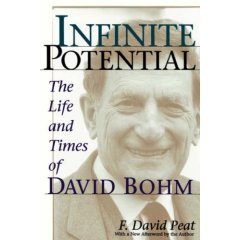
A younger colleague, David Bohm, in the 1950s became interested in developing a deterministic understanding of quantum mechanics. He did not like that the usual interpretation had no underlying theoretical framework. A strongly intuitive physicist, he favored models he could picture or experience at some level. Like Einstein, he also thought it impossible that information could travel instantaneously between particles--- or faster than the speed of light.

His answer was a model in which a quantum potential guides the behavior of particles in a deterministic but holistic way. (Bohm's work built on an earlier attempt by Louis de Broglie in the 30's to provide an alternate explaination.) For example the quantum potential tells the electron whether one or two slits is open--- see above video---and guides it so the observed results occur. The quantum potential is able to this because it contains what Bohm called “active information” about the entire system. In effect, it allows the particle to “just know” the big picture.

Meanwhile in the 60s another physicist named John Bell , influenced by Bohm, proved theoretically that to extend determinism to subatomic particles would necessarily imply what has come to be called non-locality---that particles far apart from each other would have to be connected or communicate at faster than the speed of light . (This is what Einstein could not accept, but 3 decades later it didn't bother Bell) In the 1980s a French team led by Alain Aspect demonstrated non-locality by performing an experiment proposed by Bohm and Bell (based on Einstein's initial thought experiment). Non-locality is sometimes called quantum entanglement, and it is now well accepted by physicist. In fact efforts are underway to exploit quantum entanglement technologically.


Bohm eventually proposed another whole realm, what he called the implicate order, as the source of the quantum potential. In the implicate realm, the two twins halfway around the universe from each other are actually connected. The implicate realm is unfolded or smeared out throughout our level of reality, what Bohm called the explicate order---like those radio waves that somehow caused my turned-off radio to broadcast music. He often used the idea of a hologram, in which every part contains an image of the whole to capture the relationship between the implciate and the explicate realm. But a hologram is static, whereas he saw the process of unfolding and enfolding between the realms going on continuously. He called it holomovement. To get a better sense of his ideas, check out this interview with Bohm.

This talk of other realms did not endear Bohm’s work to mainstream physics. To add insult to injury, he worked closely with the Indian teacher Krishnamurti for many years. Nonetheless a small number of physicists preferred his causal or ontological model and have worked to refine and extend it. It is now called Bohmian mechanics.

Even though the quantum potential reinstates causality, it leaves us with a universe very different from the commonsense world we experience. ( It is important to point out that none of this affects the laws of physics at the macroscopic level, but rather our picture of the subatomic realm.) In what we generally call objective reality, distant objects only affect each other when a signal of some sort, a communication, travels between them. To rescue locality as well as causality the way we usually think of them, like Bohm, we have to accept another level of reality where distant particles really are close together.


This is quite a trade-off! At the same time there is something that rings true about this situation. I mean this in the sense that things very often do seem to turn into their opposites. In any case, all us dummies can take comfort in something Richard Feynman said, "I think it is safe to say that no one understands Quantum Mechanics."

So far there has been no way to test Bohmian mechanics against the usual interpretation of quantum mechanics that claims that randomness rules. Just recently some preliminary data about the density of the early microwave radiation left over from the big bang seems to support Bohmian mechanics---according to Antony Valentini (also see first reference below and very end of post). If it is confirmed, it will cause quite a stir!


Additional Web Information:

Written in the skies: why quantum mechanics might be wrong, 2008, Nature On-Line (It is limted access, but important so I've reproduced the critical paragraphs below).


Quantum Randomness May Not be Random, 2008, New Scientist


David Bohm and the Implicate Order, by David Pratt


Do Deeper Principles Underlie Quantum Uncertainty and Nonlocality? 2005, Science


Interesting short video about the early history of quantum mechanics

&&&&&&&&&&&&&&&&&&&&&&&&&&&&&&&&&


Written in the skies: why quantum mechanics might be wrong
Published online 15 May 2008 Nature doi:10.1038/news.2008.829
Zeeya Merali

'snip'

Almost all measurements of the cosmic microwave background seem to fit well with the predictions of quantum mechanics, says Valentini. But intriguingly, a distortion that fits one of Valentini’s proposed signatures for a failure of quantum mechanics was recently detected by Amit Yadav and Ben Wandelt at the University of Illinois at Urbana-Champaign (see 'Deflating inflation?'). That result has yet to be confirmed by independent analyses, but it is tantalizing, Valentini adds.

“It’s far too early to say that this is definite evidence of a breakdown in quantum mechanics — but it is a possibility,” he says.

Hiranya Peiris, an expert on the cosmic microwave background at the University of Cambridge, UK, is impressed by the new work. “This is a pretty cool new idea,” she says. “Nobody has ever thought of using the cosmic microwave background to look into really fundamental quantum questions — cosmologists just assume that quantum mechanics is correct,” she says.

But Peiris adds that Valentini must now come up with more detailed predictions about the types of distortion that will arise in the cosmic microwave background to convince cosmologists that they are really caused by a breakdown of quantum mechanics. “He has thrown some really exciting ideas out there, but now he needs to do the nitty-gritty calculations,” she says.

September 05, 2007

Wolfgang Pauli on Kepler and the Transition from Alchemy to Classical Science


When I opened my new guidebook at random, of all things, it happened to fall on a page listing an alchemical museum. I was delighted at the thought of visiting on my upcoming trip to Prague what was billed as the only alchemical museum in the world. Yet when I looked a second time I saw it was closed for the summer. Instead I had to satisfy myself with rereading an article on alchemy by physicist Wolfgang Pauli I had found very thought provoking. He uses the work of Johanus Kepler as a lens through which to view the transition from alchemy to the classical scientific perspective.

Pauli is best known for his work on the spin of elementary particles. As a particle physicist he grappled closely with the wave particle duality. He also was a patient and collaborator of Carl Jung. He worked with Jung to integrate the intuitive, imagistic, and feeling material that came through his dreams with his much stronger thinking side. Like Jung, he came to feel that both mind and matter were manifestations of the same primary material or force prior to both. The article called "The Influence of Archetypal Ideas on the Scientific Theories of Kepler" appears in a volume with an essay of Jung's on synchronicity. The book is entitled The Interpretation of Nature and the Psyche and was first published in 1955.

Kepler (1571-1630) was a devout Christian with mystical tendencies as well as an important figure in the history of science. Converted to the Copernican heliocentric universe early in his career by his tutor, he became obsessed with proving that the planetary orbits were circular. He was strongly influenced by, among other things, neo-Platonic philosophy, which explored the harmonious mathema
tical relationships behind music and tried to generalize these to nature as a whole. Kepler saw the Divine in the regularity of geometry and saw the cosmos as what might be called Divine Geometry. The sphere was for him the most perfect geometric form. He felt its harmonious proportions encoded the Triune Christian God (with the Son standing for Creation), the relationship of the soul to the body, of God to the human soul, and, at least early on, of the sun to the planets. (The picture is a model of Kepler's early view of the solar system.) He thought the soul responded instinctively to the harmonies of the sphere because, as Pauli puts it, by virtue of its circular form [it] is an image of God, in Whom these proportions and the geometric truths following therefrom exist from all eternity. " Below are a few passages from Harmonices mundi, Kepler's book on "the harmony of the worlds."

... the movement of a point located in the center [of the sphere] to a single point on the surface, represents the first beginning of creation, emulating the eternal generation of the Son in that the center flows out towards infinitely many points of the whole surface, which, under the rule of the most perfect equality, is formed and described by infinitely many lines; and this straight line is, needless to say, the element of corporeal form.

The point spreads itself out over this extension so that point and surface are identical, except for the fact that the ratio of density and extension is reversed. Hence there exists everywhere between point and surface the most absolute equality, the closest unity, the most beautiful harmony[literally: breathing together!], connection, relation, proportion, and commensurability. And although Center, Surface, and Distance are manifestly Three, yet they are One, so that no one of them could be imagined to be absent without destroying the whole.

...the circle beautifully fits into the intersecting plane (of which it is the circumscribed limit) as well as into the intersected sphere by way of a reciprocal co-incidence of both, just as the mind is both inherent in the body, informing it and connecting with corporal form, and sustained by God, an irradiation as it were, that flows into the body from the divine countenance; whence it [the mind] derives its nobler nature.

Alas poor Kepler, working with the careful astronomical data collected by Tycho Brahe, found that the planetary orbits are not circular. However his commitment to geometry had not failed him since he eventually was able to show that they are elliptical. He also determined that a planet swept out equal areas of its orbit in equal time periods
(click for an animation of Kepler's 2nd Law. Finally he recognized the mathematical relationship between the (mean) distance of a planet from the Sun and the size of its orbit. By doing so he found a much more complex harmony in nature, which finally enshrined the sun at the center of the universe. Kepler's work was essential to the formulation of the law of gravity by Newton, who lived from 1643 to 1727.

----------


The final part of Pauli’s article explores the vitriolic controversy between Kepler and his contemporary Robert Fludd, a practitioner of alchemy.

Kepler's understanding of a rational universe ultimately grounded in the harmonies of mathematics collided with the traditional alchemical view based on a “archaic-magical” apprehension of nature in which boundaries between the real and the symbolic were completely absent. Like Kepler, Fludd understood the Divine to be reflected in the cosmos, yet much more dimly. Thus the relationship between the Divine and his creation was not harmonious for Fludd and other alchemists. They saw a cosmic struggle between form as the light principle, and matter, or darkness, which dwells in the earth. This struggle could only be redeemed by the alchemical process, which releases from matter its latent light and by the same token transforms the alchemist. The pictures below, what Fludd called "hieroglyphic figures," demostrate his view of the cosmos.


Pauli writes, "Fludd never distinguishes clearly between a real, material process and a symbolical representation. Because of the analogy of the microcosm to the macrocosm the [al]chemical process is indeed at the same time a reflection of the whole universe.... After the withdrawal of the formal light principle matter remains behind as the dark principle, though it was latently present before as a part of God…. In the middle, the sphere of the sun, where these opposing principles just counterbalanced each other, there is engendered in the mystery of the [al]chymic wedding the infans solaris, which is at the same time the liberated world soul."


Quantitative measurement has no role in, and was indeed a threat to, Fludd's understanding of the universe. Pauli quotes Fludd's spirited attack on Kepler's Harmonicies mundi and defense of the alchemical approach.

...What he has expressed in many words in long discussions I have compressed into a few words and explained by means of hieroglyphic and exceedingly significant figures, not, to be sure, for the reason that I delight in pictures (as he says elsewhere), but because I…had resolve to bring together much in little and, in the fashion of the alchemists, to collect the extracted essence, to reject the sedimentary substances, and to pour what is good into its proper vessel; so that, the mystery of science having been revealed, that which is hidden may become manifest; and that the inner nature of the thing after the outer vestments have been stripped off, may be enclosed, as a precious gem set in a gold ring, in a figure best suited to its nature---a figure, that is, in which its essence can be held by eye and mind as in a mirror and without many-worded circumlocutions.

For it is for the vulgar mathematicians to concern themselves with quantitative shadows; the alchemists and Hermetic philosophers, however, comprehend the true core of the natural bodies.

...I contemplate the internal and essential impulses that issues from nature herself; he has hold of the tale, I grasp the head; I perceive the first causes, he its effects.


Kepler answers:

If you know of another mathematics (besides that vulgar one from which all those hitherto celebrated as mathematicians have received their name), that is, a mathematics that is both natural and formal, I must confess that I have never tasted of it, unless we take refuge in the most general origin of the word...and give up the quantities. Of that, you must know, I do not speak here. You, Robert, may keep for yourself its glory and that of the proofs to be found in it---and how accurate and how certain those are, that, I think you will judge for yourself without me. I reflect on the visible movements determinable by the senses themselves, you may consider the inner impulses and endeavor to distinguish them according to grades. I hold the tale but I hold in my hands; you may grasp the head mentally, though only, I fear, in your dreams. I am content with the effects, that is, the movement of the planets. If you shall have found in the very causes harmonies as limpid as are mine in the movements, then it will be proper for me to congratulate you on your gift of invention and myself on my gift of observation---that is, as soon as I shall be able to observe anything.

Pauli points out that Kepler, a transition figure, overstates the empirical impetus behind his ideas. Pauli is also unwilling to side completely with the quantitative mode that Kepler defends, lamenting what was lost in the transition to the classical science that was to come. (Even thought Newton was a devoted alchemist, he kept his scientific work and writing separate from his alchemical concerns.)

Whereas as Kepler conceives of the soul almost as a mathematically described system of resonators, it has always been the symbolical image that has tried to express, in addition, the immeasurable [emphasis added] side of experience which also includes the imponderables of the emotions and emotional evaluations. Even though at the cost of consciousness of the quantitative side of nature and its laws, Fludd’s "hieroglyphic" figures do try to preserve a unity of the inner experience of the "observer" (as we should say today) and the external processes of nature, and thus a wholeness in its contemplation....

Pauli felt psychology as well as physics was beginning to bridge the gap between the quantative and qualitative that Kepler's work helped bring about. My sense is that more than 60 years after Pauli's article, this important coming together of the quantitative and the qualitative is still just beginning.

December 04, 2006

Science vs. Religion: Bridging the Gap

The gym is not a place I associate with insight into the important spiritual or intellectual issues of our day. Nor for that matter is Time Magazine. I had just finished my workout on the elliptical machine and was on my way to the weight room when I glanced at the magazine table in the hall and in the corner of my eye caught the cover of Time. The cover article “God vs. Science” got my attention. Yet it was as much the spaciousness of the cover design that held my interest. In contrast to Time’s usual dark and busy cover, it was a large white field mostly empty except for an uncurled DNA double helix sauntering down its length to one side. The DNA bases turned into rosary beads and the "molecule" ended up holding a cross--- but I didn't see that until later. I grabbed the magazine and brought it with me to the weight room.

The body of the article turned out to be a debate between an evolutionary biologist and a Christian geneticist. Richard Dawkins , a well-known evolutionary biologist is virulently anti-religion: his recent book is called The God Delusion. The geneticist, Francis Collins, led the effort to decode the genome: his recent book is called The Language of God: A Scientist Presents Evidence for Belief. A while back I heard Dawkins debate a leading intelligent design proponent on NPR. I am very attached to the idea of evolution---to its power and elegance: my sympathies were certainly not with the fundamentalist. However I felt there was something lacking in the case that Dawkins made. Evolution and a sense of a deeper purpose or meaning to existence than that of the material world are not necessarily opposed to each other. I have trouble with the concept of God, but I do believe in the reality of something beyond the material world.

Francis Collins, the geneticist argued--- as do many scientists of faith--- that the fact that the six universal or cosmological constants work out to be just what they have to be to support life indicate that the universe was the handiwork of God. Most scientists agree that if even one constant had been a little off in one direction after the Big Bang--- for example if the gravitational constant had been off by one part in 100 million million --- the expansion of the universe would not have occurred in a way that would have eventually supported life. This is called the anthropic principle.

Dawkins countered in part that this assumes that the cosmological constants are fluid rather than fixed.

"People who believe in God conclude there must have been a divine knob twiddler who twiddled the knobs of these half-dozen constants to get them exactly right. The problem is that this says, because something is vastly improbable, we need a God to explain it. But that God himself would be even more improbable. Physicists have come up with other explanations. One is to say that these six constants are not free to vary. Some unified theory will eventually show that they are as locked in as the circumference and the diameter of a circle. That reduces the odds of them all independently just happening to fit the bill."

Certainly it is difficult to imagine the divine knob twiddling. Yet much more interesting to me is the other tact he and others use to argue against the difficult to account for coincidence implied by the universal constants working out just right to support life. If there were not just one, but a very large number of universes with different cosmological constants, then finding one where everything worked out right would not be so wondrous and would not necessitate an underlying intelligence.

"The other way is the multiverse way. That says that maybe the universe we are in is one of a very large number of universes. The vast majority will not contain life because they have the wrong gravitational constant or the wrong this constant or that constant. But as the number of universes climbs, the odds mount that a tiny minority of universes will have the right fine-tuning."

In response Collins invokes Occam’s razor, saying that he finds the idea of a designer a simpler hypothesis than postulating a large number of alternative universes.

"This is an interesting choice. Barring a theoretical resolution, which I think is unlikely, you either have to say there are zillions of parallel universes out there that we can't observe at present or you have to say there was a plan. I actually find the argument of the existence of a God who did the planning more compelling than the bubbling of all these multiverses. So Occam's razor--Occam says you should choose the explanation that is most simple and straightforward--leads me more to believe in God than in the multiverse, which seems quite a stretch of the imagination."

This helps illustrate what is so often true. One person’s Occam's razor, or simpler explanation, is another person's Mount Everest--- or nearly impossible impasse. I have to say that I am with Collins on this one (though I would posit an intelligent force rather than a designer-- which is too” knob twiddling” for me). An intelligent force seems to be simpler to me than an almost infinite number of universes. Yet I'm not sure which I would think the simpler hypothesis if I didn't have sporadic experiences that support the existence of a deeper and more sophisticated force working in us and through us. My personal concept of spirituality is pretty much grounded in those brief moments in which I get hints of this larger consciousness in the cosmos.


Notice I said nearly impossible impasse above when remarking that one person's Occam's razor is another person's Mount Everest. Alas Dawkins, a scientist with a large theoretical reach---in spite of his strong antireligious bias --- does seem able to make an assent. He says,

"I accept that there may be things far grander and more incomprehensible than we can possibly imagine…My mind is open to the most wonderful range of future possibilities, which I cannot even dream about, nor can you, nor can anybody else. What I am skeptical about is the idea that whatever wonderful revelation does come in the science of the future, it will turn out to be one of the particular historical religions that people happen to have dreamed up…. If there is a God, it's going to be a whole lot bigger and a whole lot more incomprehensible than anything that any theologian of any religion has ever proposed."

Thus Dawkins is not necessarily arguing against mystery, but just for greater mystery that can be contained in God as a historical concept. A wise not so old man I met recently, when I told him about this debate, gave me a new sense of why Jews are not supposed to say the word God. Perhaps Annie Dillard , whose books have a strong spiritual thread (see Oct 26), captures this best---for our unholy and minimalist age--- when she writes, “I don't know beans about God.”
------------------------------------------------------------------------
------------------------------------------------------------------------
Paul Tallant wrote me after reading my piece that he had some thoughts about science and religion. I encouraged him to put them in writing and submit them as a comment. The result was so comprehensive and moving to me and also so parallel to what I had written in certain ways --- I decided that it fit best right afterwards. Paul's views are not exactly the same as mine, but they come close in many areas.
No Essential Difference by Paul Tallant

Acknowledgment: I am grateful to Lois Isenman for her encouragement to write this note and for her gentle and thought-provoking comments and queries as I wrote it.

I was waiting in the doctor’s office and spied a copy of the 17 July 2006 Canadian issue of Time. The cover with a cowboy hat sporting a Presidential Seal and boots protruding beneath caught my attention initially, but my eyes rapidly shifted to one of the cover’s sub-captions; “Exclusive Einstein Letters.” I started reading Walter Isaacsons’s feature “The Intimate Life of A. Einstein,” however my name was called before I finished (a seemingly infrequent event in the patient-waiting rooms of Canadian medicine). After my appointment, the receptionist told me I could borrow the issue. I returned home with it and placed it on my night-time reading table. At bedtime, after reading Isaacson, I discovered David Van Biema’s article “Reconciling God and Science” in the “Religion” section of same issue of Time. Naturally I began reading Van Biema. I did not turn out the light until I had read his entire account of Francis Collins’s personal encounters with God and how Collins reconciles his work in science with his beliefs in the Divine---taken from Collin’s new book The Language of God: A Scientist Presents Evidence for Belief.
Serendipitously, Lois Isenman’s post, a doctor’s appointment, and a five-months old copy of Time provided me an opportunity to comment on a subject that, in various incarnations, has held my attention for years. I thank Lois for the opportunity to describe briefly the latest edition of my thoughts regarding God and science.

I believe in God. I believe in evolution. And I believe that those two beliefs are intrinsically harmonious. But this harmony is infrequently heard amid the crescendo of a commonly perceived dissonance between God and science. It is the perceived dissonance that likely led Van Biema to title his piece “Reconciling ---” and similarly for Lois to title her’s “--- Bridging –“

I grew up with beliefs far more conservative than those of Collins. Early-on I believed in a “young” Earth, and essentially accepted the Genesis story as an account of Divine science. But Collins does not take that tack and is quite clear in his view about the Genesis account. He says “I don’t think God intended Genesis to teach science.” I now agree with Collins.

Collins’s approach to spirituality was different than mine. Collins was hiking in the Pacific Cascades and encountered a frozen waterfall with the shape of three distinct streams. From those frozen forms Collins recognized the Trinity and surrendered to Jesus Christ. My hike was figurative. It seemed that on a thickly-clouded night I was deep in the Barrens of the Avalon Peninsula, Newfoundland Canada, seeking to return to the only road that led back home to Witless Bay, a small ex-fishing community near St. John’s. I was lost. But out of the darkness appeared a woman who was studying to be a rabbi. She handed me a copy of Minyan, Ten Principles for Living a Life of Integrity by Rabbi M. Shapiro and said “read it.” I did.

Rabbi Shapiro’s account of the foundation of spirituality is strongly credible to me because he is a Jewish Rabbi who has moved spiritually beyond both his Orthodox upbringing and the Reform rabbinical training he received. In “Minyan –“ Shapiro gives a moving account of his experience as a rabbinic student. Shapiro says:

“I delivered a sermon on the necessary unity of God, woman, man and nature. Immediately after the service I was called into the office of the chairman of the philosophy department for a scholarly reprimand.”

“Referring to my position that God and creation are one, the chairman said; ‘You sir are a megalomaniac.’”

“”With all due respect, Rabbi,’ I said, you are wrong. If I understand the term correctly, a megalomaniac thinks he is God. I, on the other hand, know I am God.’”

“What I meant to convey and doubt very much that I did, was my deep conviction that God is not something or someone living somewhere in or out of time and space. To me God is the One who manifests as all things in time an space. God is not something you pray to, but rather the greater reality to which you awake.” (Italics mine.)

Rabbi Shapiro’s approach to spirituality is in a sense similar to Collins avowing a belief in God and concurrently possessing acknowledged stature in molecular genetics. Shapiro moved beyond the traditions of his cloth and Collins embraced a spiritual belief not common among his scientific peers. I take the essence of Shapiro’s thesis to be that God dwells within each of us, is indescribable, is Love, and is accessible through the exercise of our own free will.

The lady with the book provided the way for me to figuratively return to the road and civilization. I believe in God and further believe that God dwells within me, and within every human being. I spent years wondering about the nature of God, feeling almost a compulsion to discover the nature of God. Lois comments about the deeper meaning of the Jewish concept of God being indescribable and un-nameable. That now is my view of God, perhaps not in the strict Jewish sense, but I recognize that neither I nor any other human can possibly define God, other than to deny God’s existence – and that is a thread-bare definition. I am now content to believe that as part of God being God, the Divine dwells within each of us. And I leave the huge remainder to God alone.

Francis Collins, when viewing the frozen waterfall, surrendered to Jesus Christ. After absorbing more of Minyan -- and the works of other thoughtful writers (for example see Williamson , Welwood , Walsch) I surrendered to God Within, to Love Within. In the broad theme of the Divine, I believe there is no essential difference between Collins’s experience and mine (and that of zillions of other spiritually inclined people)--- what difference there is lies in human viewpoints. I believe further that there exists a perspective that presents these seemingly different views of God as a single Wholeness.

The notion of “no essential difference” applies also to my belief about a “gap” between science and religion, or the need to “reconcile” God and science. Within the broad theme of the Divine, I believe that there is no difference, no gap, and no need for reconciliation. I believe that nature is an explicit revelation of God and that science is the tool available to us humans to learn of the “testable” part of the Divine.

Lois quotes Richard Dawkins as saying, "I accept that there may be things far grander and more incomprehensible than we can possibly imagine…” She also quotes Annie Dillard as saying, “I don't know beans about God.” Van Biema describes an exchange between Collins and a Ph.D. candidate at a meeting of Harvey Fellows in Alexandria Virginia. The student asked Collins if he felt that evolution applied to everything else but humans. Collins responded that such a position would get you into real trouble. Collins also said “the human genome contains nonfunctional elements in the precise spot where they can be found on chromosomes of lower animals.” Then Collins asked a question and provided his own answer. “If God was creating humans afresh, why would He insert a pseudo-gene that has lost its ability to do anything in the same place that it appears in a chimp? “ Collins continued “Barring evolution, you are forced to the conclusion that God was trying to mislead us and test our faith and I have trouble with that kind of conjecture.”

Physicists have long recognized the extreme sensitivity of the nature of our Universe to the value of fundamental physical constants. From the Big Bang on, very slight changes in one or more of these constants would have resulted in a dramatically different Universe than what we observe today. And as Lois describes, argument and controversy in the context of God swirls about the origin of the value of these constants.

In graduate school one of the most important things I learned about representing physical phenomena is to use a coordinate system that is intrinsically appropriate to the process itself. For example, if a process inherently has spherical geometry, don’t describe it or cast it in Cartesian coordinates; you’ll only create a symbolic mess for yourself. On a more abstract level, a coordinate system is simply a formality through which details of phenomena can be visualized. It is a perspective through which to view the behavior of a process or system.

Personally, I take the approach of choosing the appropriate “coordinate system”, the appropriate perspective to solving the issue of God and science. If you do not believe in God, then you have the “trivial” solution; there is only science and no need to look further. But if with me you admit the existence of God, then I believe we require a figurative “coordinate system,” a yet undiscovered and undefined perspective, a point-of-view, that will allow the “problem” of God and science to be resolved with efficacy and integrity.
This perspective must deal with both the spiritual and the physical. The spiritual requires faith, the physical intrinsically does not; it is “testable.” With Annie Dillard, I don’t know “beans about God.” But I believe that God exists and I believe with Rabbi Shapiro that the Divine dwells within me and within each of us humans. I further believe with Collins that DNA is a “language of God,” that evolution exists and that it has been and continues to be active in our world. I also believe with Richard Dawkins that “—there may be things far grander and more incomprehensible than we can possibly imagine –.” I further believe that a perspective exists that contains an elegant and non-trivial solution to the issue of God and science. And finally, when viewed via this perspective, I believe we will discover that the solution contains no essential difference between God and science.

November 22, 2006

The Furnace and the Stove: Another Fable (with a strong personal note)

My older brother came to visit for a few days the weekend after I changed the old converted coal furnace for a spanking new boiler (Reason vs. Intuition). After about 20 minutes, I commented jokingly on my restraint at not yet having asked him to come see the new furnace. Immediately he marched downstairs to the cellar--- with me following. “It certainly is different,” he remarked, as he checked out clean-lined red heatsource that replaced the indomitable old snowman that had held court in the nether region of this our family home for eighty years.

Later over dinner he noticed that I had also replaced the old stove in the kitchen. (It was 5 years ago, when the third of four burners on the 60’s era electric stove became unusable. The new furnace apparently primed him to see the handsome, not quite new stove.) Half joking, and buoyed by good wine, I opined that replacing the stove was like getting rid of mother and the furnace, dad. We the children were finally in charge, I thought. It's way past time and all for the good.

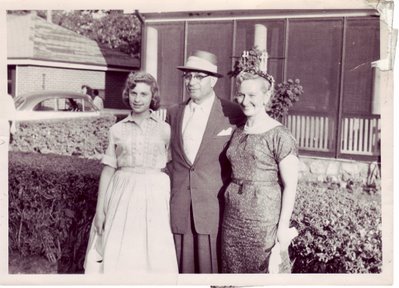
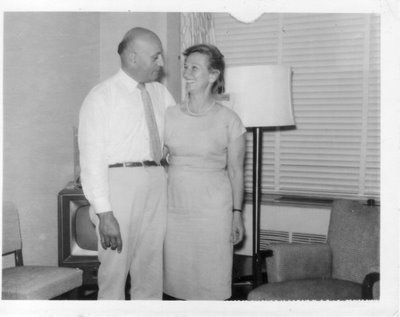
Sometimes in spiritual circles it is said that you choose your parents. Besides the biological absurdity of this, it never made sense to me because I was clear that I never would have chosen the parents I got. They were good people; intelligent, funny, with excellent values---but nonetheless challenging parents.

My father was a patriarch with a scientific bent, who did not easily allow emotion or other people's needs.


“Dad, I have a question.”
“The answer is no, now what is your question?”

My mother was emotional and, as might be expected, increasingly needy over time. The strongly receptive part of her nature was constantly at war with the equally strong independent side. A truth teller, she was very often right. Yet even when she was right, in context she was frequently wrong. The house was too often a complex battle scene between my mother and father, or my mother and my mother, or my mother and everyone else.

A few days after my brother's visit, my aunt and I--- based on a plan we made months before--- went to the cemetery where my parents as well as her mother are buried. I had been to the family gravesite two or three times before and had found it a vaguely peaceful experience. The man in a yarmulke and jacket at the tasteful but frigid administration center pulled out a magnifying glass to find the site on his mimeographed plan of the cemetery. “Oh boy,” I thought, “this is going to be tough to find.” My concern grew when he realized that the first mark he had made on the map was incorrect and had to go through the procedure again.

Carefully following all the roadside indicators, we went round and round in circles between the carefully landscaped Mount of Olives and Mount Tabor. (I suspect a map of the Holy Land would have been more helpful than the mimeographed plan I had in hand.) “Perhaps they had recycled old the plot and sold it to someone else,” crossed my mind. After about 45 minutes---with the help of some reluctant maintenance men, we found the spot. I bristle at this kind of poor administrating, and I had to work actively to calm myself.

When I finally sat down on the small bench, my parents’ presences immediately filled my mind. I felt transported into a place of wordless communication and connection with them both. Most remarkable of all to me was how well my being fit with theirs. I never remember having ever experienced such clear consciousness and deep emotional connection before. We were separate --- it was a precondition for this delightful exchange--- but we were at the same time inexorably joined. This joining was harmonious, yet complex and dynamic--- like a wonderful rich trio sonata. It was an experience of complete spiritual communion . I don't know whether we choose our parents, but if we do, I now understand why I would have chosen mine. I also understand the rightness of their choice of each other.


I also don't know if the presences I felt were actual presences from the beyond, or my internalized sense of my parents. Because it's a simpler hypothesis and because I have no experiential evidence to the contrary, if pressed, I would definitely say the latter. But the answer to this question doesn't matter to me at all. Even if they were internalized presences--- it was a real encounter with internalized presences. This in the end might be more even more important. Replacing these weighty relics of my mother and father's material existence ---the furnace and the stove--- --- rather than excising parents, seems to have freed me to experience their spirits more deeply.

Like their material doppelgangers, they each gave a different kind of fire. My father's fire, the fire of the furnace, warmed and sustain life. It forged truth of the practical and worldly kind. My mother's fire, the fire of the stove, was of the psyche---it transformed the world so it could be absorbed. Its truth was the truth of essences---seeing through the surface of things to their intangible core.


I certainly would change many things, if I could do it again with executive control. But I see that---besides being formed by the very rich consciousness of these two beings --- I have inherited from each a priceless gift. From my father, I have inherited my analytic, scientific mind that strives for clarity. From my mother, I have inherited unusual receptivity and an interest in the powerful yet subtle reality of what we cannot see. Their vital fires are both part of me.

About 10 years ago, after a number of working as years as a scientist, I began studying intuition. There is lots of dissonance where I now sit right in the middle of the bridge between the furnace and the stove---the science and the experience of intuition. On one side is cutting edge science of the mind and on the other, subtle experience---including spiritual experience. My work has inherited the complaints of each side of the divide for the other side. A number of the scientists find it too experiential or anecdotal, and a number of the experience people are resistant to the analytic material.

I believe these often warring sources of transforming heat, the furnace and the stove, must learn to speak each other's language and to understand each other's truths. I am glad to be one of the crucibles in which this alchemical marriage is now occurring. The wonderful heat of this joining is such that, even with all the dissonance, there is no place else I would rather be.

November 12, 2006

Reason vs. Intuition


A number of books of an academic or semi-academic nature have appeared in the last number of years on intuition. Many of them highlight the conflict between reason and intuition. However, I think for the most part this is a false dichotomy, one of the many reasons I do not like these books. Also they only tilt their hats to intuition, while their deeper subtext seems to be that intuition is not to be trusted.

Intuition and reason most often work together. In fact, evolution demands that this is so. If they didn't, we never would have been successful as a species. For the most part, the confluence of reason and intuition occurs below the level of awareness, so we are not aware it is happening. Instead we only become aware of the relatively infrequent situations in which the two conflict. Very recently I did encounter one of those situations.

There was a small chance that the furnace could be fixed. My intuition told me not to replace it, but my reason said yes. The old one was a converted coal furnace, the original in the house---which was built in 1926. They were called “snowmen,” because that's what they looked like all covered with asbestos. It's time, I thought. I don't want it to fail in the middle of winter, especially if I am away on a trip.


It was not easy to say goodbye to all the funky bells and whistles of my old snowman. In fact, I saved the wonderful old pressure gauge to put on top of my shiny new heat box as a masthead of sorts. I now have a new spiffy red furnace, half the size of the old one. But guess what ---it turns out that the pipes bang when the heat comes on, which did not happen with the old one.

I thought I would call the company that installed the furnace and ask them to try to fix the banging. But my intuition said no! I didn't know why, but it seemed a serious warning ---so I didn't call.

The banging has woken me up several nights running. It also regularly jams the voice activated word processor I use. This is silly I thought, why suffer like this? So yesterday I again decided to call the company. Again my intuition said no. But this time I called anyway. They said they would come today; here I sit waiting for the repair man.

What is going on? First of all, a matter of definition: I am calling this an intuition because it came through the same channel my intuition generally does and with enough force for for me to listen to its guidance. This is not a rigorous treatment of this complex and thorny issue, but it will do to begin with.

One possibility is that this dire warning about the furnace was based on some precognitive knowledge. Perhaps the furnace is a lemon, the company is not trustworthy, or the repair man will come and make things worse. I certainly cannot exclude any of these possibilities.

However there is another possibility that is at least as interesting and as instructive with respect to understanding intuition. I live in the house I grew up in (I have lived many other places as well). The deep steady purr of the furnace played base to my father's rhythmic snoring. Together they were the nightsong of the house. At an emotional level in some sense removing the old furnace means removing my father and his influence---for better and for worse---from the house. Thus what seems to be a conflict between reason and intuition instead may well reflect an emotional conflict between my loyalty to the past and moving on. I'm not sure this is the reason my “intuition” is kicking up a fuss--- but I do know I have a lot of emotion going on this highly symbolic act of replacing the furnace/father.

Emotion and what we call intuition are highly linked. Gut feelings or any bodily feelings connected to decision making are just another way of saying emotion---as the work of Antonio Damasio
has shown. This is what makes going with your gut a reasonable bet much of the time. It is also why ‘going with your gut’ cannot always be trusted.

But is ‘going with your gut’ intuition? It is certainly one of the components involved in intuition, and often an important one, yet not necessarily the only one. The best way to think of it is as one level of intuition.
The emotions that generate gut feelings are a double edge sword. They have an important role to play in decision-making and likely in all intellectual activity, but by the same token they can also lead us astray. This is especially true when these decisions are attached to unresolved emotional conflicts--- even if only symbolically. Most of the time, however, as Damasio's book Descartes' Error: Emotion, Reason, and the Human Brain shows, emotion and reason work together seamlessly.

Another of my complaints with books that stress the dichotomy between intuition and reason is that they do not provide even the beginning of a framework for thinking about or holding situations in which they seem to conflict. (One of them did say that we should train intuition to be scientific! But this seems to be throwing out the baby with the bathwater.) We need a larger framework, since no one-size-fits-all or any other simple approach will do.

My book tries to lay a framework for understanding this very complicated issue by resonating in-depth experiential exploration with in-depth scientific exploration. This framework may not help anyone decide whether to replace a wonderful old furnace or not. But it will interest them in paying careful attention to their experience over time. It will also interest them in the broad scientific questions involved in unveiling this elusive mental capacity we call intuition. The two approaches to exploring intuition begin to bootstrap on each other in a very interesting way. More than in most areas, experiential understanding and scientific understanding of intuition must work together.

November 09, 2006

Another True Fable

Credit: Yerkes National Primate Research Center

Cool Like You


By Gretchen VogelScienceNOW Daily News3 November 2006


Humans excel at following conventions. In France, acquaintances greet one another with a kiss on the cheek. In Japan, they bow. The different greetings have no inherent use on their own--and they would each lose their meaning when performed in the wrong context. But are humans the only animals to use such social conventions? A new study in chimps suggests not; the primates can learn an arbitrary behavior and pass it along to their groupmates.

The behaviour in question involved objects that chimps would normally deem useless. Graduate student Kristin Bonnie of the Yerkes National Primate Research Center in Atlanta, Georgia, and her colleagues provided two groups of chimpanzees with either a bucket with a hole cut in the side or a container with a large tube sticking out of the top. Out of sight of the other group members, the researchers trained one high-ranking female from each group to deposit tokens into either the bucket or the tube. The team then sat back and watched to see if that trained behavior would spread.

Indeed, the other animals quickly realized that the trained group member was receiving treats--apple or banana slices--for picking up the tokens and placing them in a container. Although treats were available for chimps that used either receptacle, each group followed their leader and used just one of the two options. There was only one exception: A low-ranking female in one group figured out she could get rewards for using the second container, but none of her group members followed her lead.

Bonnie and her colleagues say the results, reported online this week in the Proceedings of the Royal Society B, suggest that the evolutionary roots of humans' tendency to follow convention are also present in our chimpanzee cousins. While other studies have shown that different chimp groups use similar tools in different ways (ScienceNOW, 22 August 2005), this is the first controlled study that shows chimps can follow conventions that don't involve tools, Bonnie says.

Check back tomorrow for another 'twist' to this fable!

October 31, 2006

Running in Herds, Traffic, and Intuition


It has always amazed me how birds can fly in formation and large animals can run in herds. You would think they would get in each other's way with disastrous consequences. Yet evolution makes sure that it works out.

Even more amazing to me is the way that we humans get from one place to another in this day and age. Much of the time this entails getting into a steel hulk with wheels on speed and sharing the roads with many other fast, steel driving machines. We are not all going the same place, even in an interim sense, unlike birds flying in formation or animals running in a herd. Nonetheless we manage to navigate even very complicated traffic with relative ease for the most part. Consider the complex information processing required to maneuver a busy traffic circle without an accident. (We have some real winners around Boston.) Evolution could not have bred us for cars or traffic circles, nonetheless even here we feel its hand.

I learned to cross streets as well as to drive a car in Harvard Square. Back then the traffic patterns in Harvard Square were all cockamamie. Crossing the street was a considerable challenge. I somehow learned that what I needed to do to get across safely was to get a glimpse of the face of the approaching driver. Immediately this would tell me whether he/she was a toughie who wanted to play chicken, or someone who would let me cross without a fight.

My intuitive education deepened when I learned to drive. I realized that you could get some sense of the other driver and his/her intentions, even when you couldn't see their face. This came through very subtle characteristics of the way they handled the car---at least at the first order approximation. It's as if you can sense something about the driver, their quality of attention, and what they are going to do next. Whatever its actual source, I suspect that receptivity to this very subtle level of information is part of what allowed us humans to have taken to the roads.