Showing posts with label spirituality/religion. Show all posts

February 17, 2019

To Publicize or Not: Is That The Question?


I recently published a book titled Understanding Intuition: A Journey In and Out of Science. It explores some foundational intuitions about intuition I experienced and brings them together with a deep dive into the science of intuition. It took me years to write and find a publisher. All told, it was a 2-decade long endeavor. Early in 2018, Academic Press, an imprint of Elsevier, a scientific publisher, issued the work.

From the experience of my colleagues at the Women’s Studies Research Center at Brandeis University, I learned that once you publish a book, your job is to publicize it. Before publication, I had assumed I would avail myself of all opportunities to promote the book, and, truth be told, a part of me looked forward to the attention. But I am also distrustful of the part of me that needs attention and recognition.

I did try this or that, but almost nothing happened on the publicity front. Fortunately, I did get two letters from stunningly intelligent readers telling that they were deeply inspired by the book. This has helped keep me from feeling very discouraged. More recently the book has received some endorsements from people whose work I greatly respect.
I am also helped by an experience that occurred during the years I was having trouble finding a publisher. I came to recognize over time that the publishing setback was likely only temporary. Because of the unusualness and importance of the material, I began to feel that it would eventually find its audience—however that might happen, and however long it might take.
But the feeling that the book would eventually be published did not eliminate the discomfort I felt. Then one evening while sweeping up the kitchen floor after dinner, I confronted myself with great sincerity about why I still felt so badly about the situation, even as I felt increasingly confident that in time the book would find its audience. Then something extraordinary happened.
As I continued to sweep, I felt the deepest and purist sense of spaciousness and Presence I ever have. My consciousness was completely altered, at least for a while. I realized that this transformed mind, which brought with it a sense of being completely safe and secure in the cosmos, was more important than publishing the book. The jewel was instead more easy access to this wonderful feeling of authenticity and quietude.

Although I am a biologist, I am also a longtime spiritual seeker. I no doubt sublimated early needs that did not get fulfilled into a search for a higher order in which these needs become transformed. I have always been drawn to people to who have a deep sense of Presence. They evoke in me a feeling of safety—a world where one does not have to fight for attention or for anything else, a world in which we are all interconnected below awareness and conflicting needs and claims are adjudicated in an enlightened and welcoming way. 

Alas, more permanent access to this quality of experience may prove even more elusive than publishing Understanding Intuition. But at least I got a clear message about what really matters to me. As I emphasize in the last chapter of the book, we each have two sides. One is focused on meeting survival needs, as well as survival-associated needs, like success. The other is focused on authenticity and Presence—on our deepest humanity. The two are not necessarily in conflict, but because of early childhood circumstances and unmet needs, they are often at odds with each other.

This split is also important to understanding intuition.  Both sides have access to intuition, but to different kinds. One kind of intuition may lead to success.  The other, a much more profound kind, leads to the knowledge of deeper truth and often to inner peace.

Destiny, whatever that might mean, has taught me a valuable, albeit, at time challenging, lesson. But now that the book has been out a year, there just might be room for something new.  Perhaps there is a way for me—and for others in certain pivotal moments in their life—to bring the two dissonant parts of ourselves closer together?

Does it have to be either/or? In my case, does it have to be seeking attention to quell what are now likely unfillable childhood needs, or continuing to feel unseen and unacknowledged as an aid to finding a more authentic way of being and the higher side of human nature?  This is an open question. 

This blog piece might just be the beginning of an answer!  Morever, maybe the need to get this timely message out to more people can help forge a bond between these two conflicting attitudes or aspects of self.  In our troubled times, which are so in need of healing, we each must do whatever we can.


July 27, 2008

EMERGENCE AND POTENTIAL SPACE


Ouroboros
Sculture by Dan Gerhart http://www.dangerhart.com/


The word "Emergence" has intrinsic appeal. It immediately leads beyond itself---to a space of potentiality. The world is wide open after that final "e"---or at least sort of. For the most part emergence is evoked after the fact. I hope to look a little more at the space beyond the final e, but first things first.

Emergence provides a way to account for the development of higher life forms and even spirituality without requiring a master plan or planner. Emergence oversimplified means that the whole is greater than the sum of its parts. A portion of its appeal is it provides an alternative to the reductive perspective, which holds that higher levels can be
completely explained by lower levels. Thus biology can be completely explained by chemistry and chemistry in turn by physics. Emergence in contrast says that novel properties can appear at higher levels that are essential to complete understanding. It implies there is always something new under the sun---or rather the potential for something new is always there.

I work together on a science and spirituality blog with a Brandeis undergraduate that we call
The Bridge: A Science and Spirituality Resource. I took on the task of summarizing an intriguing but challenging article by Terrence Deacon for the blog entitled “Emergence: The Hole at the Wheel's Hub.” At the end of my second time through the 40 page paper I had one of those experiences in which science and spirituality really converged for me. The moment of insight intensified during several subsequent readings. It marked a considerable deepening of my morning meditation and perhaps other aspects of my spiritual life as well.

The primary purpose of Deacon's article was not spiritual, but instead to impart some order to the promiscuous concept of emergence by characterized three different levels. However he brings all three together under the Eastern-seeming concept of absence, a potential shaped by what is not there. He quotes from the
Tao Te Ching

Thirty spokes converged at the wheel’s hub to an empty space that makes it useful. Clay is shaped into a vessel, to take advantage of the emptiness it surrounds. Doors and windows are cut into walls of a room so that it can serve so some function. Though we must work with what is there, use comes from what is not there.

First something about the basic idea behind emergence. Thermodynamics tells us that the universe is running downhill and becoming increasingly random. In a state of randomness a change in one direction is balanced by change in the opposite; everything cancels everything else out. How then is life possible, to say nothing of the purposefulness on which we humans so pride ourselves? After all, we are---including our minds---part of nature.

The answer is that the way things fit together---relational properties---instead of a canceling each other out, may, depending on a confluence of events, build on each other. These relational or configural properties are responsible for the spontaneous production of order, such as the formation of whirlpools and also the origins of life. They explain why our organism can turn over most of the physical material it is made of and nonetheless persist.

Deacon’s three levels of emergence represent three critical transitions in the organization of matter. At the first level, higher order properties can emerge when separate elements become an aggregate. (These phenomena can be explained reductively, but including this level provides a complete sweep of the terrain.) For example, when H2O molecules aggregate, the properties of liquidity emerge. Becoming a liquid gives rise to characteristics such as surface tension and different kinds of flow that depend on the molecules’ relationship to each other. Not only H2O but many different kinds of molecules can become liquids. The characteristic behavior associated with liquidity, its “laws,” then become a higher level description of these systems.

The second level transition describes the emergence or self-organization of form. Here first-order emergence becomes unstable. An example is a Benard cell. When a shallow pan of water or other liquid is heated evenly from the bottom, hexagonal convection cells emerge. All different kinds of convection patterns occur initially but they cancel each other out. Only the hexagonal cells survive because their close packing is most efficient at bringing the heat to the surface.

The emergence of form occurs when random fluctuations at a lower level---here water molecules rising to the surface to remove the heat---give rise to relational regularity at higher levels that are beneficial to the system. These beneficial regularities in turn influence the lower levels to support this arrangement---the two work together so only hexagonal cells form. The kind of causality that occurs in these self-organizing systems is decidedly circular. As Deacon puts it, “interaction dynamics at lower levels becomes strongly affected by regularities emerging at higher levels of organization.”

Another example of a self-organizing system is the spontaneous generation of autocatalytic sets. Heterogeneous molecules form together into a cycle where, for example, A catalyzes the formation of B, B catalyzes the formation of C, and C of A. These cycles are very important in cellular metabolism. All that is needed to keep them going is the availability of raw materials and an energy flow through the system.


Check out this video which shows a very sexy autocatalytic cycle called a Belousov-Zhabotinsky Reaction.


With the third transition, some sort of informational memory is present, for example genetic material. This allows emergent forms to be reproduced over and over again. Think of it like a franchise with loose corporate control. Reproduction can then occur over time and even space. This memory is what makes development and evolution possible and by the same token gives a history to the system. The ability of self-organizing forms to reproduce---so their occurrence is no longer dependent on spontaneous self-organization---is arguably where life begins. These systems have a purpose of sorts---to reproduce and undergo change that enhances the possibility of not being canceled out.

These higher-level emergent systems are shaped by absence in several different ways. They are forged not by design, but by what is not canceled out. The forms that arise and then reproduce depend to a large extent on factors external to them, such as their fit with environmental conditions. Life and the mind to which it has given rise---in part because this passive selection goes on---is ever governed by the 'pull of yet unrealized possibility.'
Notice there is something quite startling to ponder here---should one be so inclined. The very notion of purpose itself implies an absence. Do we have it backwards?

Here is the passage close to the end that showed me how deeply this paper---which at that point I at best barely understood---had gotten to me.

Like something coming out of nothing, the subject of self is, in effect, a constitutive absence for the sake of which new constitutive absence is being incessantly evolved. In this sense, there is some legitimacy to the eliminativist claim that there is 'no thing' that it is. Indeed this must be so. The locus of self is, effectively, a negative mode of existence, that can act as an unmoved mover of sorts: a non-thing that nonetheless is the locus of a form of inertia---a resistance to change--- with respect to which other physical processes can be recruited and organized.


When I read that (the second time through) I had one of those powerful moments of knowing in which I could capture only a little of what was being known. As a student of intuition I suspect these are the best kind. I any case I am happy my unconscious was doing its job.

I felt myself to be a mere input/output tube. There was an intense focus of energy around my mouth, one of the ways into or indeed out of the devise. I enjoyed the minimalism and cleanliness of sensing myself as nothing more than this tube and the energy that served as its gate---of being largely without a self for an instant.

It was an experience of spiritual absence or emptiness, but not the kind of spiritual emptiness that verges on transcending the physical realm. Rather it was an emptiness that was pregnant with the most elementary aspects of human life---of feeding and of speaking, which lent it a hearty, almost animal-like vitality. It was also pregnant with everything I was not worrying about that would take care of itself. Finally it was pregnant with all that would flow through me and I might take in and perhaps transform. I felt very simple and very free. There was just potential space.


November 18, 2007

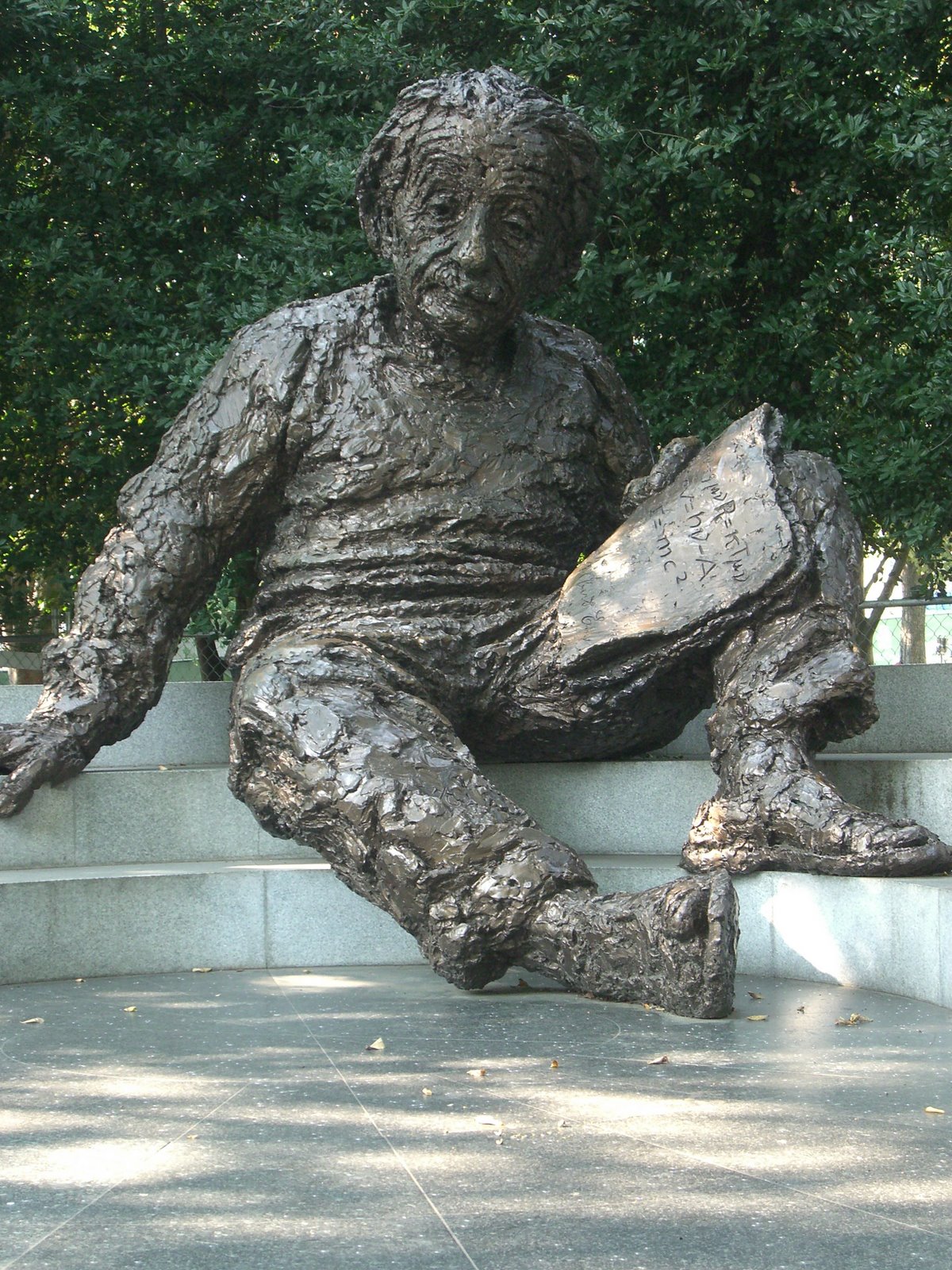
EINSTEIN'S INTUITION


After reading Isaacson's book on Einstein, which I heartily recommend, I picked up a book I took out of the library a while ago and kept renewing. It is called Einstein and the Poet: In Search of the Cosmic Man, by William Hermanns. Until Einstein came alive for me, came out from behind the myth thanks to Isaacson, I had no mental place for it.

It consists of four interviews with Einstein by Dr. Hermanns, who was initially Einstein's fellow Berliner and then his fellow exile. Hermanns is a sociologist and poet, who has strong mystical leanings and little understanding of physics. The first interview takes place in Berlin as the Nazis are gaining strength and becomes entwined with marching Brownshirts. It is both a wonderfully and terrifyingly bizarre piece, and it would make a striking movie or perhaps play.

The next three interviews take place in the United States during and after the war. Although lacking the drama of the first, they are equally informative. Hermanns continually goads Einstein to talk about things that he is not comfortable talking about, such as mysticism, and then pokes fun at his own obtuseness for continuing to press him. Nonetheless Einstein reveals a great deal to him. The interviews contain a treasure trove of information about Einstein's understanding of intuition. I thought I had the intuition bug, Einstein had it even worse!

Intuition can take many different forms. I identified deeply with a portion of what Einstein said about it. "Yes that's what it's like for me," I found myself saying with wonderment and even delight at the recognition. This kinship to some of what Einstein evoked no doubt comes from the fact that we share a personality type.

After I finished the book, I copied down some quotes I found particularly moving or informative. By putting them one after the other and pondering them a bit I came to see that they formed a coherent, profound, and provocative worldview.

Intuition for Einstein—be it about cosmic law or about predicting the outcome of the Second World War—is intimately connected with feeling. Many associate both feeling and intuition with the gut. But for Einstein, intuition is grounded primarily in the feeling of the heart—in its receptivity and its tendency to move out. It depends on a deep caring and receptivity that pushes him to go beyond what is currently known or thought or happening in order make contact with the cosmic order.

The following passage comes when Einstein and Herrmanns are talking about the Nazis and the flaw in the German national character that lead to Hitler's appeal.

Einstein nodded: he was a good listener. After a pause he said, "The cosmic man must be restored, the whole man who is made in the image and likeness of the arch-force, which you may call God. This man thinks with his heart and not with party dogma. As I've explained before, there is an order in the universe – a cosmic order – and humans have the possibility of understanding these laws."
Einstein leaned back in his chair; so did I,putting my writing pad on my knees. He added, "I have no doubt that the allies will win the war."
I smiled, "Oh, you are my prophet again."
"Prophet or not," he scratched his head, "what I say is more often felt through intuition than thought through intellect."

Hermanns is constantly pushing Einstein to acknowledge his inherent mysticism. He succeeds in getting Einstein to say something that probably few scientists today would say—that there is a vital force or energy in creation. Einstein is willing to associate energy with what are generally seen as spiritual concepts.


I pulled out some notes. "Once, in England, I was at dinner with people highly trained in meditation, among them Professor Suzuki who asked me to ask you if spiritual vibrations and electricity have the same original cause or force."
"I believe," Einstein answered, "that energy is the basic force in creation. My friend Bergson calls it élan vital, the Hindus call it prana."

This acknowledgment of at least certain types of energy that cannot, or not yet, be measured by instruments is noteworthy but it is perhaps not completely surprising. Einstein was responsible for showing us that matter and energy are interchangeable. He understood empiricism to be only a tool of intuition. Finally like Spinoza, he saw God, the universe, and all of life as a harmonious whole.

Einstein looked through the window and seemed to mumble more to the trees than to me, "I believe that I have cosmic religious feelings. I never could grasp how one could satisfy these feelings by praying to limited objects. The tree outside is life, a statue is dead. The whole of nature is life, and life, as I observe it, rejects a God resembling man. I like to experience the universe as one harmonious whole. Every cell has life."
He turned to me and smiled, "Matter, too, has life: it is energy solidified. Our bodies are like prisons, and I look forward to be free, but I don't speculate on what will happen to me. I live here , and my responsibility is in this world now..."

Experiencing the universe as a harmonious whole, there is no reason to fear either life or death. True religion depends only on holding the world in a receptive, caring, and judicious way—on conscience. This opens the door to intuition, which allows at least Einstein to glimpse the law conformability of the universe (and the rest of us too, although no doubt somewhat more dimly).

"The truly religious man has no fear of life and no fear of death—and certainly no blind faith: his faith must be in his conscience. Then he will have the intuition to observe and judge what happens around him. Then, he can acknowledge that everything unfolds true to strict natural law, sometimes with tremendous speed."

As a part of the cosmic order, certainly Einstein, and perhaps all of us, have a purpose which we can recognize with our intuition. Since our instructions or purpose comes from this harmonious whole, we are participating in eternity in the present.


"Indeed, it is not intellect, [which means book knowledge and empiricism for him], but intuition which advances humanity. Intuition tells man his real purpose in this life... I do not need any promise of eternity to be happy… my eternity is now. I have only one interest: to fill my purpose here where I am. This purpose is not given to me by my parents or my surroundings. It is induced by some unknown factors. These factors make me part of eternity. In this sense I am a mystic...”

As an inherent part of this totality, we are much larger than we usually experience. Einstein's religion, like Spinoza's, is that the universe is rational. The highest calling is to ponder its laws. Our usual ways of knowing are crude and cannot comprehend the coherence and beauty of the universe. Only the heart with its intuition can lead us beyond what we know of the universe and of ourselves.

Einstein leaned forward, "… it is not a religion that teaches that man is made in the image of God—that is anthropomorphic. Man has infinite dimensions and finds God in his conscience. This religion has no dogma other than teaching man that the universe is rational and that its highest destiny is to ponder it and co-create with its laws. There are only two limiting factors: first, that what seems impenetrable to us is as important as what is cut and dried; and: second that our faculties are dull and can only comprehend wisdom and
serene beauty in crude forms, but the heart of man through intuition leads
us to greater understanding of ourselves and the universe."

Although intuition is what allows us to move forward—is the most important part of thinking—it alone is not enough. Knowledge also has its place, but intuition is the gatekeeper at the most critical juncture. Even though the workings of intuition remain mysterious, it is a reality.

"Isn't truth inherent in man?" I interjected. "You once told me that progress is made only by intuition, and not by the accumulation of knowledge."
"It's not as simple as that," replied Einstein. "Knowledge is necessary, too. An intuitive child couldn't accomplish anything without some knowledge. There will come a point in everyone's life, however where only intuition can make the leap ahead, without ever knowing precisely how. One can never know why but one must accept intuition as a fact."

October 12, 2007

ON BEING JEWISH

This piece is composed of two separate but somehow linked powerful experiences of being Jewish. The first occurred on a recent trip to Budapest. The second occurred many years ago on a trip that began in Poland and continued in Israel.

1) Budapest: Summer 2007

It was my first day of sightseeing in Budapest. I had decided to leave the Jewish quarter until after the four day conference I was attending---the official purpose for my visit. I had been warned that the story of Hungarian Jewry just before, as well as during, the Holocaust was particularly dark. Hungary was an ally of Germany during the war, had passed its own exclusionary laws in the 20s, and until the very end took care of its "Jewish problem" on its own.

Much of the afternoon I walked around the inner city assiduously following a walking tour in my Frommer's guidebook to Budapest. Determined to pack as much into the day as I could, I crossed over the Danube to Buda and took the funicular up the hill to the castle district. In addition to its monumental buildings, the castle district consists of a number of streets with attractive small houses. The guidebook listed a number that were of note. One, at Tancsics Mihaly u. 26, had been a medieval Jewish prayer house. This is what Frommer's had to say.

This building dates from the 14th century. In the 15th and 16th century, the Jews of Buda thrived under Turkish rule. The 1686 Christian reconquest of Buda was soon followed by a massacre of Jews. Many survivors fled Buda; this tiny Sephardic Synagogue was turned into an apartment.

The house was distinguished by its color and a tiny bronze plaque saying it had once been a synagogue. I can visualize it now close to the corner of the street, painted a tasteful yet alive orange--- what I think is called burnt orange. I love that shade of orange; one of my first thoughts was that its inhabitants were lucky to live there.

Then I saw unbidden in my mind's eye men in long dark frocks and yarmulkes, wearing intelligent, worldly expressions, coming out of the building, perhaps after prayers. They did not seem exotic or even strange to me. Instead I experienced a striking kinship in consciousness with them, perhaps more so than with any other figures I have read about and/or conjured in my mind from the past. I felt I knew them---could feel their inner current, sense their joys and concerns and how they held them together. I continued on my tour, without even thinking of taking a picture.

While I was recounting my adventures to myself at the end of the trip, I left this one out. In the back of my mind I knew there was one more, of a slightly different kind. Indeed the image was among the most vivid I've ever had ---at least of things I have not actually seen or experienced.


2) Poland, Museum at Auschwitz: Summer 1979.

Close to the end of the exhibition, the photos gave way to canvases showing Jewish life. A tableau of a bar mitzvah boy reading from the torah, flanked on one side by his father and on the other by the rabbi, conveyed both in the treatment of the figures and the light, a strong sense of the sustained upward impulse of Judaism towards spirit. In it I discovered the basic religious urge that is at the core of the Jewish experience. From childhood on, even as a reformed Jew, I had experienced it again and again, but mythically in the sense that I could not abstract its meaning from the experience. I realized that even as an agnostic, I had been strongly influenced by this very gentle reach of my community upward toward the sacred. Before it had been somewhat comforting to unknowingly partake of it from time to time; here at Auschwitz I understood what it was, saw how much it had shaped me, and realized its sustaining power.

Israel---Summer 1979

After visiting Auschwitz, I longed to be in Israel. However, once there I felt dispirited and disoriented. I blamed the heat in August and being alone after having been so well cared for in Poland. From my current vantage point I recognize that my distress resulted from my recent encounter with the destruction of European Jewry and the impossibility of satisfactory integrating these events.

As I was going through the motions of being a tourist, I met an English actor, about ten years older than me, on a camping tour of the Sinai Peninsula. An orphan, he had been brought up by the Jesuits. When I told him of my visit to Auschwitz, he shared the Jesuit perspective on anti-Semitism. Christianity was viewed by his teachers as an advance over Judaism because it offered the hope of resurrection. The resurrection of Christ held the promise of the induction of individual souls into a heavenly life at death. The rejection by Jews of Christ was then a rejection of the concept of individual afterlife. The basic impulse of Western anti-Semitism, my friend felt, arose from an unconscious mechanism by which Christians who lack faith in the possibility of life after death combat their inner doubts about life after death by attacking those who do not believe in the resurrection of Christ.

I was intrigued by the ability of this theory in one deft stroke to account for so much. It seemed to explain Hitler's obsession with a "final solution" and his sense of it as righteous work in a particularly powerful way. At one level I was convinced, but at others harbored some doubts. Even though I knew Reform Judaism does not mention life after death, I was poorly informed about other Jewish views. Moreover, the Messianic tradition clearly implies a resurrection of a sort.

Later I found out that the focus of the Jewish tradition is indeed generally on present life: on reaching to God through ritual observance, prayer and even complaint, on acts of loving kindness, and on social justice. However various Rabbis over the centuries have spoken of individual resurrection and afterlife. The mystical arm of Judaism emphasizes the fate of the soul after death. But they teach that originally a spark of divine light, the soul at death merges with its divine source.

I returned to Jerusalem and said good-by to my actor friend. A day or two later, my eyes happened to meet those of a pleasant, simply dressed young man. In part from the extraordinary depth of repose I experienced when our eyes met, I realized in an intuitive flash that this man was a Christian---and a true one. I understood the tranquility and penetrability of this apparently simple young man to reflect his close grounding here in the Holy Land---possibly even unsullied by scientific thought---to a religion that holds at its core the view that individual life can continue in some manner after death.

Whether this man in fact was a Christian is not important. He embodied for me in its purest form a different organizing filter than my own and my tradition to the question of living. I am still engaged, and suspect I will be for a long time, in the process of reclaiming from that unconscious place where intuitions come from and are again stored all the insight inherent in that moment when my eyes met those of this young man.

In the years since I returned from this trip, I have become more involved in Judaism and spiritual life. I yearn, I question and I wrestle, in the manner of many Jews, to know first hand that organizing filter or psychic signature of my religion at its best. I first saw it fully amid all the death at Auschwitz.

************************************
These passages were part of an early version of a chapter for an anthology on growing up Jewish in America, called Daughters of Kings. In the end I decided not to include the story about my actor friend and his theory about anti-Semitism in my chapter, called "The Other Side." In it I write about growing up in the shadow of the Holocaust, attending a Trinitarian boarding school, and the trip I took to Poland, Auschwitz, and Israel after handing in my dissertation.

September 05, 2007

Wolfgang Pauli on Kepler and the Transition from Alchemy to Classical Science


When I opened my new guidebook at random, of all things, it happened to fall on a page listing an alchemical museum. I was delighted at the thought of visiting on my upcoming trip to Prague what was billed as the only alchemical museum in the world. Yet when I looked a second time I saw it was closed for the summer. Instead I had to satisfy myself with rereading an article on alchemy by physicist Wolfgang Pauli I had found very thought provoking. He uses the work of Johanus Kepler as a lens through which to view the transition from alchemy to the classical scientific perspective.

Pauli is best known for his work on the spin of elementary particles. As a particle physicist he grappled closely with the wave particle duality. He also was a patient and collaborator of Carl Jung. He worked with Jung to integrate the intuitive, imagistic, and feeling material that came through his dreams with his much stronger thinking side. Like Jung, he came to feel that both mind and matter were manifestations of the same primary material or force prior to both. The article called "The Influence of Archetypal Ideas on the Scientific Theories of Kepler" appears in a volume with an essay of Jung's on synchronicity. The book is entitled The Interpretation of Nature and the Psyche and was first published in 1955.

Kepler (1571-1630) was a devout Christian with mystical tendencies as well as an important figure in the history of science. Converted to the Copernican heliocentric universe early in his career by his tutor, he became obsessed with proving that the planetary orbits were circular. He was strongly influenced by, among other things, neo-Platonic philosophy, which explored the harmonious mathema
tical relationships behind music and tried to generalize these to nature as a whole. Kepler saw the Divine in the regularity of geometry and saw the cosmos as what might be called Divine Geometry. The sphere was for him the most perfect geometric form. He felt its harmonious proportions encoded the Triune Christian God (with the Son standing for Creation), the relationship of the soul to the body, of God to the human soul, and, at least early on, of the sun to the planets. (The picture is a model of Kepler's early view of the solar system.) He thought the soul responded instinctively to the harmonies of the sphere because, as Pauli puts it, by virtue of its circular form [it] is an image of God, in Whom these proportions and the geometric truths following therefrom exist from all eternity. " Below are a few passages from Harmonices mundi, Kepler's book on "the harmony of the worlds."

... the movement of a point located in the center [of the sphere] to a single point on the surface, represents the first beginning of creation, emulating the eternal generation of the Son in that the center flows out towards infinitely many points of the whole surface, which, under the rule of the most perfect equality, is formed and described by infinitely many lines; and this straight line is, needless to say, the element of corporeal form.

The point spreads itself out over this extension so that point and surface are identical, except for the fact that the ratio of density and extension is reversed. Hence there exists everywhere between point and surface the most absolute equality, the closest unity, the most beautiful harmony[literally: breathing together!], connection, relation, proportion, and commensurability. And although Center, Surface, and Distance are manifestly Three, yet they are One, so that no one of them could be imagined to be absent without destroying the whole.

...the circle beautifully fits into the intersecting plane (of which it is the circumscribed limit) as well as into the intersected sphere by way of a reciprocal co-incidence of both, just as the mind is both inherent in the body, informing it and connecting with corporal form, and sustained by God, an irradiation as it were, that flows into the body from the divine countenance; whence it [the mind] derives its nobler nature.

Alas poor Kepler, working with the careful astronomical data collected by Tycho Brahe, found that the planetary orbits are not circular. However his commitment to geometry had not failed him since he eventually was able to show that they are elliptical. He also determined that a planet swept out equal areas of its orbit in equal time periods
(click for an animation of Kepler's 2nd Law. Finally he recognized the mathematical relationship between the (mean) distance of a planet from the Sun and the size of its orbit. By doing so he found a much more complex harmony in nature, which finally enshrined the sun at the center of the universe. Kepler's work was essential to the formulation of the law of gravity by Newton, who lived from 1643 to 1727.

----------


The final part of Pauli’s article explores the vitriolic controversy between Kepler and his contemporary Robert Fludd, a practitioner of alchemy.

Kepler's understanding of a rational universe ultimately grounded in the harmonies of mathematics collided with the traditional alchemical view based on a “archaic-magical” apprehension of nature in which boundaries between the real and the symbolic were completely absent. Like Kepler, Fludd understood the Divine to be reflected in the cosmos, yet much more dimly. Thus the relationship between the Divine and his creation was not harmonious for Fludd and other alchemists. They saw a cosmic struggle between form as the light principle, and matter, or darkness, which dwells in the earth. This struggle could only be redeemed by the alchemical process, which releases from matter its latent light and by the same token transforms the alchemist. The pictures below, what Fludd called "hieroglyphic figures," demostrate his view of the cosmos.


Pauli writes, "Fludd never distinguishes clearly between a real, material process and a symbolical representation. Because of the analogy of the microcosm to the macrocosm the [al]chemical process is indeed at the same time a reflection of the whole universe.... After the withdrawal of the formal light principle matter remains behind as the dark principle, though it was latently present before as a part of God…. In the middle, the sphere of the sun, where these opposing principles just counterbalanced each other, there is engendered in the mystery of the [al]chymic wedding the infans solaris, which is at the same time the liberated world soul."


Quantitative measurement has no role in, and was indeed a threat to, Fludd's understanding of the universe. Pauli quotes Fludd's spirited attack on Kepler's Harmonicies mundi and defense of the alchemical approach.

...What he has expressed in many words in long discussions I have compressed into a few words and explained by means of hieroglyphic and exceedingly significant figures, not, to be sure, for the reason that I delight in pictures (as he says elsewhere), but because I…had resolve to bring together much in little and, in the fashion of the alchemists, to collect the extracted essence, to reject the sedimentary substances, and to pour what is good into its proper vessel; so that, the mystery of science having been revealed, that which is hidden may become manifest; and that the inner nature of the thing after the outer vestments have been stripped off, may be enclosed, as a precious gem set in a gold ring, in a figure best suited to its nature---a figure, that is, in which its essence can be held by eye and mind as in a mirror and without many-worded circumlocutions.

For it is for the vulgar mathematicians to concern themselves with quantitative shadows; the alchemists and Hermetic philosophers, however, comprehend the true core of the natural bodies.

...I contemplate the internal and essential impulses that issues from nature herself; he has hold of the tale, I grasp the head; I perceive the first causes, he its effects.


Kepler answers:

If you know of another mathematics (besides that vulgar one from which all those hitherto celebrated as mathematicians have received their name), that is, a mathematics that is both natural and formal, I must confess that I have never tasted of it, unless we take refuge in the most general origin of the word...and give up the quantities. Of that, you must know, I do not speak here. You, Robert, may keep for yourself its glory and that of the proofs to be found in it---and how accurate and how certain those are, that, I think you will judge for yourself without me. I reflect on the visible movements determinable by the senses themselves, you may consider the inner impulses and endeavor to distinguish them according to grades. I hold the tale but I hold in my hands; you may grasp the head mentally, though only, I fear, in your dreams. I am content with the effects, that is, the movement of the planets. If you shall have found in the very causes harmonies as limpid as are mine in the movements, then it will be proper for me to congratulate you on your gift of invention and myself on my gift of observation---that is, as soon as I shall be able to observe anything.

Pauli points out that Kepler, a transition figure, overstates the empirical impetus behind his ideas. Pauli is also unwilling to side completely with the quantitative mode that Kepler defends, lamenting what was lost in the transition to the classical science that was to come. (Even thought Newton was a devoted alchemist, he kept his scientific work and writing separate from his alchemical concerns.)

Whereas as Kepler conceives of the soul almost as a mathematically described system of resonators, it has always been the symbolical image that has tried to express, in addition, the immeasurable [emphasis added] side of experience which also includes the imponderables of the emotions and emotional evaluations. Even though at the cost of consciousness of the quantitative side of nature and its laws, Fludd’s "hieroglyphic" figures do try to preserve a unity of the inner experience of the "observer" (as we should say today) and the external processes of nature, and thus a wholeness in its contemplation....

Pauli felt psychology as well as physics was beginning to bridge the gap between the quantative and qualitative that Kepler's work helped bring about. My sense is that more than 60 years after Pauli's article, this important coming together of the quantitative and the qualitative is still just beginning.

June 05, 2007

FOOD AND THE SPIRIT (or Re-Dedicating my Dissertation Twenty Seven Years Later)


I have a rare chance to make up for a lost opportunity. I had wanted to dedicate my PhD thesis to Julia Child. The topic had nothing to do with cooking, at least in the way the word cooking is generally used. I was studying how digestive enzymes, which are large proteins that break down the food we eat, get from the pancreas where they are made into the gut.


Instead when push came to shove I decided to dedicate it to my younger brother. He had died my junior year in college of cystic fibrosis, just shy of the age of thirteen. Cystic fibrosis is a disease in which digestive enzyme secretion is impaired and children cannot breakdown the food they eat. That's him below at my older brother's wedding---capturing the action. Had Bruce lived, he---not I---would have been the scientist in the family. Not least because my dissertation happened to be on digestive enzyme secretion, it seemed right to dedicate it to Bruce. I am glad I did.


I was drawn to the idea of dedicating my dissertation to Julia because learning to cook from her exceptional cookbook gave me the courage I needed to go into science. An intuitive type, I had always been a bit spacey. I had assiduously avoided serious science, and especially laboratory science, feeling it alien to the likes of me. Learning to cook in the years just after college under Julia’s tutelage gave me confidence in my ability to weigh and measure. She did much more; she helped ground me in the world of sensation and also introduced me to the pursuit of excellence.


Though nominally I was teaching, my real job---and joy---was cooking. In the beginning my love affair with Julia and fine food took place in a tiny closet of a kitchen with no counter space what-so-ever and only a 2 x 2.5 foot table. Nonetheless I followed almost every step of her recipes as if they were sacred texts that held the secret to life. In some sense to me that's just what they were--- and I suspect I was not the only one. Julia opened this country up to the joys of the palate and much more.


I wonder did Julia serve as a stepping stone into science for anyone else---or am I the only one? As a youngster I knew science was supposed to be about observing the natural world, but little I saw jibed with what scientists supposedly said--- like apples and feathers falling at the same rate. At another level the control and precision that experiments required was not associated with women for me. Women didn't control the environment, men did. I don't think a male Julia Child, clarity, nonchalance, breathiness and all, would have had the same influence on me. Because Julia was a woman, she gave me permission; once I had begun to master French Cooking, the possibility of mastering other things became real to me as well.


My skill with cooking eventually went beyond just following Julia’s instructions. As I mentioned in my last post "Intuition and Brussels Sprouts," sometimes when I put myself in a special non–thinking but completely attentive state while adjusting the seasoning of the dish, I would know just when it was enough. Cooking tends to involve great deal of implicit learning, unconscious information processing, and expertise. However the connection between cooking and intuition is even deeper.


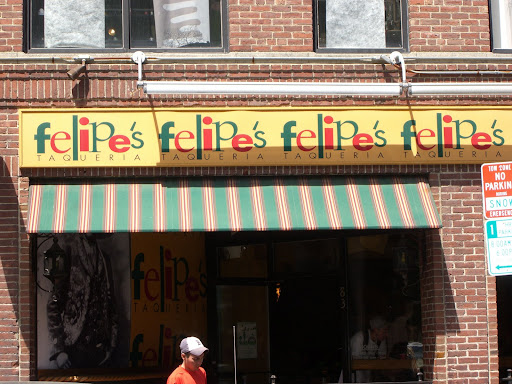
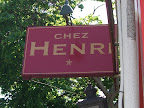
Years ago, when a friend and I were traveling together throughout Western US and Canada, she taught me to choose restaurants by their signs. It turned out to be a pretty good rule of thumb--- a restaurant with an appealing sign generally had correspondingly good food. Over the years, I have thought a lot about what this special something is that goes beyond good design.

Sometimes even a very simple restaurant sign or simple cooking rises to the level of art. Like all art, it depends on a combination of knowledge, skill, and creativity that ‘cook’ together below awareness---in short on intuition. Yet I feel that artistic quality is neither necessary nor sufficient to explain a sign that draws you into a restaurant or the good food that so often goes with it. Sometimes a sign that bespeaks good food to me can by no stretch of the imagination be called art.


I suspect some even more basic intuitive alchemy connects the sign an owner of a restaurant chooses to hang to invite people in and the food they prepare. Both share an inherent movement or dynamism that appeals and sometimes even fascinates. We feel enriched by looking at them or tasting them—and perhaps especially when the dynamism is ‘oh so subtle.’ (It might come from a just barely perceptible rhythm to the lettering or composition.) The sign forms an appealing as well as self-sustaining, or continuing, pattern in space--- and the food an appealing and self-sustaining pattern of tastes. These patterns resonate with something etched in the human spirit. To the extent we linger with them, they connect us more deeply to ourselves and also at the same time connect us to something larger than ourselves.


On Julia's website at the Smithsonian below a picture of her in the kitchen in France where she first started to cook is a quote from her “The whole thing was an opening up of the soul and spirit for me." Food is the most direct way we take in the external world and make it part of ourselves. Much of the time we eat without awareness. We are just following our biological imperative to survive. But when we do it with consciousness, this transmutation of world into self can also become a bridge between the sensual and spiritual. To begin with, as the tradition of saying grace highlights, we appreciate the bounty of the earth.


When the food is really delicious---to the extent we savor it--- we are also led into different and more rarefied realms of appreciation and even joy. The cook who pats herself on the back for making a wonderful new dish, in addition to appreciating her own skills, is celebrating---even when she doesn't know it---the slightly enlarged world of nuanced experience her own intuition has opened for herself and guests. (Of course, this opening might instead depend on the intuition of others codified in a recipe, combined with her skill.) When she makes and serves an old favorite, she revisits that special place again.


If you want to get heightened sense of the way food can carry one beyond oneself to new places, you might try a radical experiment---eating a wonderful meal in the company of friends in complete silence. It is hardly anti-social! Rather to the extent one remains present, it leads to an intensified experience of both food and friends. “It is the nectar.” as a friend who I convinced to lunch in silence on the veranda of a lovely restaurant in Italy during a busy conference said. Alas, Julia opened the possibility of experiencing this nectar for so many of us.


Had I dedicated my thesis to Julia back then, my appreciation of her influence on my life would have been incomplete. I was still years away from my current interest in exploring and resonating the experience and science of intuition. But what is a mere twenty seven years when completeness is at stake? Here is the original dedication, and below what I would now add:


This dissertation is dedicated to Bruce Isenman. He wanted to be a scientist, and I believe nothing would have stopped him had he lived.

This study is also dedicated to Julia Child. By teaching me to weigh and measure with the best of them, she gave me the confidence I needed to become a scientist. I now know that she also helped chart my course beyond to resonate more subtle yet no less real realms of knowledge and experience with scientific understanding.


************************************
************************************


OTHER RESTAURANT SIGNS I THINK INTERESTING
(A Work In Progress)

I have not eaten at all these restaurants whose signs I think bespeak good food or find interesting for one reason or another. It is no doubt a better test of the rule when the food is unknown. (I apologize for the quality of some of the pictures. I am using Picasa for the first time, and the quality of the uploads seem inconsistent. Any insight appreciated.)


I am not sure about what these signs reveal, but I am certainly intrigued by them. The restaurant has been there since my college years and back then had excellent subs. It recently closed.


This one has changed hands at least once and probably more---so it might be a legacy issue as well.

The signs in the foodcourt of the Porter Exchange in the old Sears Building in Cambridge seem to be all by the same artist. They are very attractive but to my mind verging on slick. I think signs by an artist hired by a corporation for a foodcourt are less telling. Most of the food is quite good at the Porter Exchange, if I remember correctly, and hardly slick!